Question
The area of the coil must be$.......$

Answer

Flux through a circular coil $\phi=\text{NBA}\cos\omega\text{t}$ Voltage required $\epsilon=\frac{-\text{d}\phi}{\text{dt}}$
$\Rightarrow9=\text{NBA}\omega\sin\omega\text{t}$
$9=\frac{8\times10^{-5}\times\text{A}\times30\times2\pi\times2000}{60}$
$\text{A}=\frac{9\times10^5}{50\times10^3}=18\text{m}^2$

Need a full question paper?

Generate a complete, print-ready paper with questions like this in minutes — across 16+ boards, with answer keys.
Start Generating Free

Similar questions

A bar magnet $A$ of magnetic moment $M_A$ is found to oscillate at a frequency twice that of magnet $B$ of magnetic moment $M_B$ when placed in a vibrating magneto$-$meter. We may say that
The rest energy of an electron is(a) 510 KeV(b) 931 KeV(c) 510 MeV(d) 931 MeV
       
A NPN transistor conducts when(a) Both collector and emitter are positive with respect to the base (b) Collector is positive and emitter is negative with respect to the base(c) Collector is positive and emitter is at same potential as the base(d) Both collector and emitter are negative with respect to the base


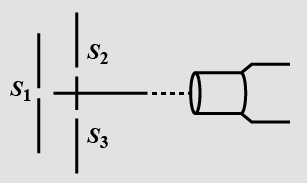
A student is asked to measure the wavelength of monochromatic light. He sets up the apparatus as shown. $S_1​,S_2​,S_{3​}$ are narrow parallel slits. $L$ is radiant lamps and $M$ is a micrometer eyepiece. The student fails to observe interference fringes. We would advice him to:
. A surface that has the same electrostatic potential at every point on it is known as _____________.
An electron microscope is superior to an optical microscope in(a) Having better resolving power  (b) Being easy to handle  (c) Low cost  (d) Quickness of observation 
   
   
The total work done on a particle is equal to the change in its kinetic energy:
  1. Always.
  2. Only if the forces acting on it are conservative.
  3. Only if gravitational force alone acts on it.
  4. Only if elastic force alone acts on it.
A region surrounding a stationary electric dipoles has:
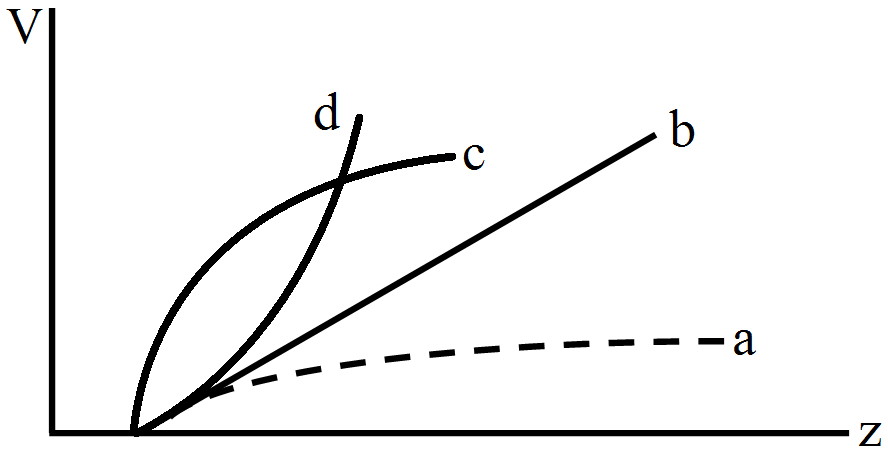
The figure shows the intensity$-$wavelength relations of $X-$rays coming from two different Coolidge tubes. The solid curve represents the relation for the tube $A$ in which the potential difference between the target and the filament is $V_A$ and the atomic number of the target material is $Z_A.$ These quantities are $V_B$ and $Z_B$ for the other tube. Then$:$​​​​​​​
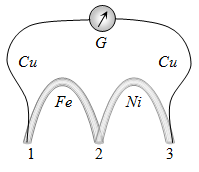
Three wires of copper, iron and nickel are joined to form three junctions as shown in Fig. When the temperature of junction $1$ is kept $50℃$ with the other two junctions at $0℃$, the sensitive galvanometer gives a deflection of $14$ divisions. When the temperature of junction $3$ is kept $50℃,$ with the other two junctions at $0℃,$ the galvanometer gives a deflection of $11$ divisions. Then the deflection given by the galvanometer, when temperature of the junction $2$ is kept at $50℃,$ with the other two junctions at $0℃,$ will be