MCQ
The atom of the element having atomic number $ 14 $ should have
  • A
    One unpaired electron
  • Two unpaired electrons
  • C
    Three unpaired electrons
  • D
    Four unpaired electrons

Answer

Correct option: B.
Two unpaired electrons
b
(b) Atomic number $14 $ eaving $2 $ unpaired electron

$_{14}Si = 1{s^2}2{s^2}2{p^6}3{s^2}3{p^2}$

Need a full question paper?

Generate a complete, print-ready paper with questions like this in minutes — across 16+ boards, with answer keys.
Start Generating Free

Similar questions

The first law of thermodynamics is only
Correct order of bond angle is
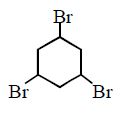
Total number of stereo isomers possible by given compound is
Electrovalent compounds do not have
Solubility of a salt ${M_2}{X_3}$ is $y\,\,mol\,d{m^{ - 3}}.$ The solubility product of the salt will be
In the structure $\begin{array}{*{20}{c}}
  {C{H_3}\,\,\,\,\,\,\,\,\,\,\,} \\ 
  {|\,\,\,\,\,\,\,\,\,\,\,\,\,\,\,\,} \\ 
  {^1{H_3}C{ - ^2}C{ - ^3}C{H_2}{ - ^4}C{H_3}} \\ 
  {|\,\,\,\,\,\,\,\,\,\,\,\,\,\,\,\,} \\ 
  {C{H_{3\,\,\,\,\,\,\,\,\,\,\,\,\,\,\,\,\,}}} 
\end{array}$ Which one is quarternary carbon atom.......
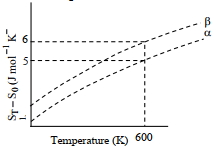
The entropy versus temperature plot for phases $\alpha$ and $\beta$ at 1 bar pressure is given. $S_{\mathrm{T}}$ and $S_0$ are entropies of the phases at temperatures $\mathrm{T}$ and $0 \mathrm{~K}$, respectively.

(image)

The transition temperature for $\alpha$ to $\beta$ phase change is $600 \mathrm{~K}$ and $C_{p, \beta}-C_{p, \alpha}=1 \mathrm{~J} \mathrm{~mol}^{-1} \mathrm{~K}^{-1}$. Assume $\left(C_{p, \beta}-C_{p, \alpha}\right)$ is independent of temperature in the range of 200 to $700 \mathrm{~K} . \mathrm{C}_{p, \alpha}$ and $C_{p, \beta}$ are heat capacities of $\alpha$ and $\beta$ phases, respectively.

($1$)The value of entropy change, $\mathrm{S}_\beta-\mathrm{S}_\alpha$ (in $\mathrm{J} \mathrm{mol}^{-1} \mathrm{~K}^{-1}$ ), at $300 \mathrm{~K}$ is. . . . . . .

[Use : $\ln 2=0.69$  Given : $S_\beta-S_\alpha=0$ at $\left.0 \mathrm{~K}\right]$

($2$) The value of enthalpy change, $\mathrm{H}_\beta-\mathrm{H}_\alpha$ (in $J$ mol ${ }^{-1}$ ), at $300 \mathrm{~K}$ is

Give the answer quetion ($1$) and ($2$)
In which of the following molecules all the effects namely inductive, mesomeric and hyperconjugation operate ?
$N{a_2}{B_4}{O_7}.10{H_2}O \xrightarrow{\Delta } X + NaB{O_2} + {H_2}O$

$X + C{r_2}{O_3}\xrightarrow{\Delta }Y$ (Green coloured)

$X$ and $Y$ are

In the following reaction, the $Cl -P -Cl$ bond angles

$PCl_5 \longrightarrow PCl_4^+ + Cl^-$