MCQ
The avalanche breakdown in $p-n$ junction is due to:
  • A
    Shift of Fermi level.
  • Cumulative effect of conduction band electron.
  • C
    Widening of forbidden gap.
  • D
    High impurity concentration.

Answer

Correct option: B.
Cumulative effect of conduction band electron.

The avalanche breakdown in $p-n$ junction is due to cumulative effect of conduction band electron. In reverse bias, due to applied electric field, electrons acquire enough energy to free more electron bound to the atom. The abundant number of electron$-$hole pairs are created for conduction, this is cumulative effect.

Need a full question paper?

Generate a complete, print-ready paper with questions like this in minutes — across 16+ boards, with answer keys.
Start Generating Free

Similar questions

An electron jumps from the $4^{\text {th }}$ orbit to the $2^{\text {nd }}$ orbit of hydrogen atom. Given the Rydberg's constant $R =10^5 cm^{-1}$ The frequency in Hz of the emitted radiation will be
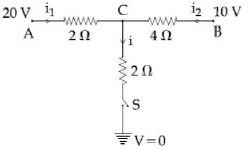
When the switch $S$, in the circuit shown, is closed, then the value of current $i$ will be ................. $A$
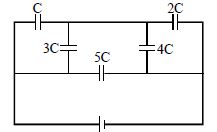
In the given circuit, ratio of charge stored in the capacitors $C, 2C, 3C, 4C, 5C$ is
If an electron revolves in the path of a circle of radius of $0.5 \times 10^{-10} \mathrm{~m}$ at frequency of $5 \times 10^{15} \mathrm{cycles} / \mathrm{s}$ the electric current in the circle is (Charge of an electron $=1.6 \times 10^{-19} \mathrm{C}$ )
As per Bohr model, the minimum energy (in $eV$) required to remove an electron from the ground state of doubly ionized $Li$ atom $(Z = 3)$ is
The ratio of radii of nuclei $_{13}A{l^{27}}$ and $_{52}{X^A}$ is $3 : 5$. The number of neutrons in the nuclei of $X$ will be
The object distance $u$, the image distance $v$ and the magnification $m$ in a lens follow certain linear relations. These are
Microwaves are electromagnetic waves with frequency in the range of:
An electric dipole of moment $\vec p$ is lying along a uniform electric field $\vec E.$ The work done in rotating the dipole by $90^o $ is
An unpolarized light passes through three polarizing sheets whose polariging directions make an angle of $30^o$ , $60^o$ and $30^o$ with $y$ axis in same sense. What fraction of initial intensity is transmitted by the system ?