MCQ
The average acceleration vector for a particle having a uniform circular motion is
  • A
    A constant vector of magnitude $\frac{v^2}{r}$
  • B
    A vector of magnitude $\frac{v^2}{r}$ directed normal to the plane of the given uniform circular motion
  • C
    Equal to the instantaneous acceleration vector at the start of the motion
  • A null vector

Answer

Correct option: D.
A null vector
(d) In complete revolution change in velocity becomes zero so average acceleration will be zero.

Need a full question paper?

Generate a complete, print-ready paper with questions like this in minutes — across 16+ boards, with answer keys.

Start Generating Free

Similar questions

A Carnot engine working between $300 \mathrm{~K}$ and $600 \mathrm{~K}$ has work output of $800 \mathrm{~J}$ per cycle. What is amount of heat energy supplied to the engine from source per cycle
Which one of the following phenomena is not explained by Huygen's construction of wavefront
When a point source of monochromatic light is at a distance of $0.2 m$ from a photoelectric cell, the cut$-$off voltage and the saturation current are $0.6 \mathrm{volt}$ and $18 \mathrm{~mA}$ respectively. If the same source is placed $0.6 \mathrm{~m}$ away from the photoelectric cell, then
If a person with a spring balance and a body hanging from it goes up and up in an aeroplane, then the reading of the weight of the body as indicated by the spring balance will
The lowest frequency of light that will cause the emission of photoelectrons from the surface of a metal (for which work function is $1.65 \mathrm{eV}$ ) will be
In P-type semiconductor, there is
The pressure of air in a soap bubble of $0.7 \mathrm{~cm}$ diameter is $8 \mathrm{~mm}$ of water above the pressure outside. The surface tension of the soap solution is
A car travels half the distance with constant velocity of $40 kmph$ and the remaining half with a constant velocity of $60 kmph$. The average velocity of the car in $k m p h$ is
A compound microscope is used to enlarge an object kept at a distance $0.03 \mathrm{~m}$ from it's objective which consists of several convex lenses in contact and has focal length $0.02 \mathrm{~m}$. If a lens of focal length $0.1 \mathrm{~m}$ is removed from the objective, then by what distance the eyepiece of the microscope must be moved to refocus the image
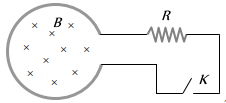
Shown in the figure is a circular loop of radius $r$ and resistance $R$. A variable magnetic field of induction $B=B_0 e^{-t}$ is established inside the coil. If the key $(K)$ is closed, the electrical power developed right after closing the switch is equal toImage