The average density of Earth’s crust $10\ km$ beneath the surface is $2.7\ gm/cm^3$ . The speed of longitudinal seismic waves at that depth is $5.4\ km/s$ . The bulk modulus of Earth’s crust considering its behaviour as fluid at that depth is
Medium
Download our app for free and get started
$v = \sqrt {\frac{B}{\rho }} $
$B$ = $\rho v^2$ = $5.4^2 × 10^6 × 2.7 × 10^3$
= $7.9 × 10^{10}\ Pa$

Download our appand get started for free
Experience the future of education. Simply download our apps or reach out to us for more information. Let's shape the future of learning together!No signup needed.*
Similar Questions
- 1Two open organ pipes of fundamental frequencies $n_{1}$ and $n_{2}$ are joined in series. The fundamental frequecny of the new pipe so obtained will beView Solution
- 2The minimum distance of reflector surface from the source for listening the echo of sound is ..... $m$View Solution
- 3View SolutionA wave is reflected from a rigid support. The change in phase on reflection will be
- 4The vibration of a string fixed at both ends are described by $Y= 2 \,\,sin(\pi x) \,\,sin\,\,(100\pi t)$ where $Y$ is in $mm$,$x$ is in $cm$,$t$ in $sec$ thenView Solution
- 5A wire of $10^{-2} kgm^{-1}$ passes over a frictionless light pulley fixed on the top of a frictionless inclined plane which makes an angle of $30^o$ with the horizontal. Masses $m$ and $M$ are tied at two ends of wire such that m rests on the plane and $M$ hangs freely vertically downwards. The entire system is in equilibrium and a transverse wave propagates along the wire with a velocity of $100 ms^{^{-1}}$.View Solution
- 6The fundamental frequency of a sonometer wire is increases by $6\, Hz$ if its tension is increased by $44\%$, keeping the length constant. The frequency of the wire is ...... $Hz$View Solution
- 7If amplitude of waves at distance $r$ from a point source is $A$, the amplitude at a distance $2r$ will beView Solution
- 8View SolutionIn a plane progressive harmonic wave, particle speed is always less than the wave speed, if
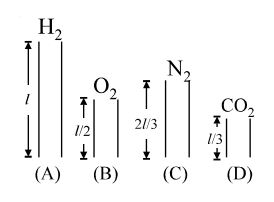
- 9Four open organ pipes of different lengths and different gases at same temperature as shown in figure. Let $f_A$, $f_B$, $f_C$ and $f_D$ be their fundamental frequencies then :[Take ${\gamma _{c{o_2}}} = 7/5$]View Solution
- 10When an engine passes near to a stationary observer then its apparent frequencies occurs in the ratio $5/3$. If the velocity sound is $340 m/s$, than the velocity of engine is .... $m/s$View Solution