MCQ
The vibration of a string fixed at both ends are described by $Y= 2 \,\,sin(\pi x) \,\,sin\,\,(100\pi t)$ where $Y$ is in $mm$,$x$ is in $cm$,$t$ in $sec$ then
  • A
    Maximum displacement of the particle at $x = 1/6 \,\,cm$ would be $1 \,\,mm$.
  • B
    velocity of the particle at $x = 1/6 \,\,cm$ at time $t = 1/600\,\, sec$ will be $157 {\sqrt 3 }\,\, mm/s$
  • C
    If the length of the string be $10\,\, cm,$ number of loop in it would be $5$
  • both $(A)$ and $(B)$

Answer

Correct option: D.
both $(A)$ and $(B)$
d

Need a full question paper?

Generate a complete, print-ready paper with questions like this in minutes — across 16+ boards, with answer keys.

Start Generating Free

Similar questions

The weight of an astronaut, in an artificial satellite revolving around the earth, is
A bob of mass $m$, suspended by a string of length $I_1$, is given a minimum velocity required to complete a full circle in the vertical plane, At the highest point, it collides elastically with another bob of mass $m$ suspended by a string of length $I_2$, which is initially at rest. Both the strings are mass-less and inextensible. If the second bob, after collision acquires the minimum speed required to complete a full circle in the vertical plane, the ratio $\frac{I_1}{I_2}$ is :
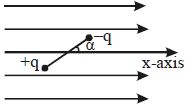
There exists a non-uniform electric field along $x-$ axis as shown in the figure below. The field increases at a uniform rate along $+ve\,\,x-$ axis. A dipole is placed inside the field as shown. Which one of the following is correct for the dipole?
A planet of mass $M$, has two natural satellites with masses $m _1$ and $m _2$. The radii of their circular orbits are $R_1$ and $R_2$ respectively. Ignore the gravitational force between the satellites. Define $v _1, L _1, K _1$ and $T _1$ to be, respectively, the orbital speed, angular momentum, kinetic energy and time period of revolution of satellite $1$ ; and $v_2, L_2, K _2$ and $T _2$ to be the corresponding quantities of satellite $2$ . Given $m _1 / m _2=2$ and $R _1 / R _2=1 / 4$, match the ratios in List-$I$ to the numbers in List-$II$.
List-$I$ List-$II$
$P$ $\frac{ v _1}{ v _2}$ $1$ $\frac{1}{8}$
$Q$ $\frac{ L _1}{ L _2}$ $2$ $1$
$R$ $\frac{ K _1}{ K _2}$ $3$ $2$
$S$ $\frac{ T _1}{ T _2}$ $4$ $8$
A public park, in the form of a square, has an area of $(100 \pm 0.2) m ^2$. The side of park is ......... $m$
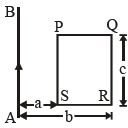
$AB$ is an infinitely long wire placed in the plane of rectangular coil of dimensions as shown in the figure. Calculate the mutual inductance of wire $AB$ and coil $PQRS$
$1$ wire mesh consisting of very small squares is viewed at a distance of $S\,cm$ through a magnifying converging lens of focal length $10\,cm$, kept close to the eye. The magnification produced by the lens is
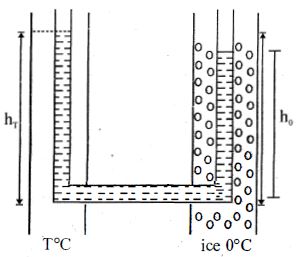
In an experiment to find the liquid expansion coefficient $(\gamma)$ a column. of experimental liquid at $T\,^oC$ is balanced against another column of experimental liquid at $0\, ^o C$ by taking them in $U-$ tube. The expansion coefficient $(\gamma)$ is ?
Let $V $ and $H $ be the vertical and horizontal components of earth's magnetic field at any point on earth. Near the north pole
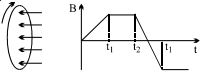
$A$ wire loop is placed in a region of time varying magnetic field which is oriented orthogonally to the plane of the loop as shown in the figure. The graph shows the magnetic field variation as the function of time. Assume the positive $emf$ is the one which drives a current in the clockwise direction and seen by the observer in the direction of $B$. Which of the following graphs best represents the induced emf as a function of time.