The average mass of rain drops is $3.0\times10^{-5}\, kg$ and their avarage terminal velocity is $9\, m/s$. Calculate the energy transferred by rain to each square metre of the surface at a place which receives $100\, cm$ of rain in a year
JEE MAIN 2014, Medium
Download our app for free and get started
Total volume of rain drops, recrived $100\,cm$ in a year by area $1\,m^2$
$ = 1{m^2} \times \frac{{100}}{{100}}m = 1\,{m^3}$
As we know, density of water,
$d = {10^3}\,kg/{m^3}$
Therefore, mass of this volume of water,
$M = d \times v = {10^3} \times 1 = {10^3}\,kg$
Average terminal velocity of rain drop
$v = 9\,m/s\,\left( {given} \right)$
Therefore, energy transferred by rain,
$E = \frac{1}{2}m{v^2}$
$ = \frac{1}{2} \times {10^3} \times {\left( 9 \right)^2}$
$ = \frac{1}{2} \times {10^3} \times 81 = 4.05 \times {10^4}J$

Download our appand get started for free
Experience the future of education. Simply download our apps or reach out to us for more information. Let's shape the future of learning together!No signup needed.*
Similar Questions
- 1View SolutionWater is flowing through a horizontal pipe of non-uniform cross-section. At the extreme narrow portion of the pipe, the water will have
- 2The velocity of upper layer of water in a river is $36 kmh ^{-1}$. Shearing stress between horizontal layers of water is $10^{-3} Nm ^{-2}$. Depth of the river is $m$. (Co-efficiency of viscosity of water is $10^{-2} \,Pa . s$ )View Solution
- 3If the terminal speed of a sphere of gold ( density $= 19.5 kg/m^3$) is $0.2\ m/s$ in a viscous liquid (density $= 1.5\ kg/m^3$ ), find the terminal speed (in $m/s$) of a sphere of silver (density $= 10.5\ kg/m^3$) of the same size in the same liquid ...... $m/s$View Solution
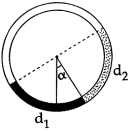
- 4There is a circular tube in a vertical plane. Two liquids which do not mix and of densities $d_1$ and $d_2$ are filled in the tube. Each liquid subtends $90^o$ angle at centre. Radius joining their interface makes an angle $\alpha$ with vertical. Ratio $\frac{{{d_1}}}{{{d_2}}}$ isView Solution
- 5View SolutionAn application of Bernoulli's equation for fluid flow is found in
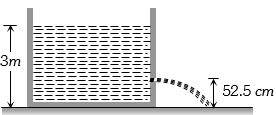
- 6Water is filled in a cylindrical container to a height of $3m. $ The ratio of the cross-sectional area of the orifice and the beaker is $ 0.1. $ The square of the speed of the liquid coming out from the orifice is ....... $m^2/s^2$ ($g = 10 m/s^2$)View Solution
- 7A Spherical ball of radius $1 mm$ and density $10.5 g / cc$ is dropped in glycerine of coefficient of viscosity $9.8$ poise and density $1.5 g / cc$. Viscous force on the ball when it attains constant velocity is $3696 \times 10^{-x} N$. The value of $x$ is $\text { (Given, } g =9.8 m / s ^2 \text { and } \pi=\frac{22}{7} \text { ) }$View Solution
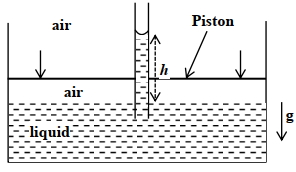
- 8An incompressible liquid is kept in a container having a weightless piston with a hole. A capillary tube of inner radius $0.1 \mathrm{~mm}$ is dipped vertically into the liquid through the airtight piston hole, as shown in the figure. The air in the container is isothermally compressed from its original volume $V_0$ to $\frac{100}{101} V_0$ with the movable piston. Considering air as an ideal gas, the height $(h)$ of the liquid column in the capillary above the liquid level in $\mathrm{cm}$ is. . . . . . .View Solution
[Given: Surface tension of the liquid is $0.075 \mathrm{Nm}^{-1}$, atmospheric pressure is $10^5 \mathrm{~N} \mathrm{~m}^{-2}$, acceleration due to gravity $(g)$ is $10 \mathrm{~m} \mathrm{~s}^{-2}$, density of the liquid is $10^3 \mathrm{~kg} \mathrm{~m}^{-3}$ and contact angle of capillary surface with the liquid is zero]
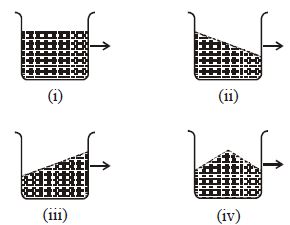
- 9View SolutionA vessel containing water is moving with a constant speed towards right along a straight horizontal path. if the vessel is given a constant retardation towards the right along a straight line, which of the above diagram represents the surface of the liquid?
- 10Water is flowing in a pipe of diameter $ 4 cm$ with a velocity $3 m/s. $ The water then enters into a tube of diameter $ 2 cm.$ The velocity of water in the other pipe is .......... $m/s$View Solution