An application of Bernoulli's equation for fluid flow is found in
IIT 1994Easy
Download our app for free and get started
(a)

Download our appand get started for free
Experience the future of education. Simply download our apps or reach out to us for more information. Let's shape the future of learning together!No signup needed.*
Similar Questions
- 1Two immiscible liquids $A$ and $B$ are kept in an U-tube. If the density of liquid $A$ is smaller than the density of liquid $B$, then the equilibrium situation isView Solution
- 2A small sphere of radius $r$ falls from rest in a viscous liquid. As a result, heat is produced due to viscous force. The rate of production of heat when the sphere attains its terminal velocity, is proportional toView Solution
- 3In Guericke's experiment to show the effect of atmospheric pressure, two copper hemispheres were tightly fitted to each other to form a hollow sphere and the air from the sphere was pumped out to create vacuum inside. If the radius of each hemisphere is $R$ and the atmospheric pressure is $p$, then the minimum force required (when the two hemispheres are pulled apart by the same force) to separate the hemispheres isView Solution
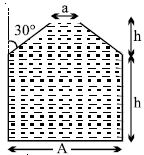
- 4The vessel shown in the figure has two sections. The lower part is a rectangular vessel with area of cross-section $A$ and height $h$. The upper part is a conical vessel of height $h$ with base area $‘A’$ and top area $‘a’$ and the walls of the vessel are inclined at an angle $30^o$ with the vertical.A liquid of density $\rho$ fills both the sections upto a height $2h$. Neglecting atmospheric pressure.View Solution
- 5A spherical ball of radius $1 \times 10^{-4} \mathrm{~m}$ and density $10^5$ $\mathrm{kg} / \mathrm{m}^3$ falls freely under gravity through a distance $h$ before entering a tank of water, If after entering in water the velocity of the ball does not change, then the value of $h$ is approximately:View Solution
(The coefficient of viscosity of water is $9.8 \times 10^{-6}$ $\left.\mathrm{N} \mathrm{s} / \mathrm{m}^2\right)$
- 6What is the pressure in $atm$ on a swimmer $10\; m$ below the surface of a lake?View Solution
- 7View SolutionA small steel ball is dropped into a long cylinder containing glycerine. Which one of the following is the correct representation of the velocity time graph for the transit of the ball?
- 8The density of the atmosphere is $1.29\, kg/m^3$, then how high would the atmosphere extend ? $(g = 9.81\, m/sec^2)$ ........ $km$View Solution
- 9A small wooden ball of density $ \rho$ is immersed in water of density $\sigma $ to depth $h $ and then released. The height $H$ above the surface of water up to which the ball will jump out of water isView Solution
- 10A uniform cylinder of length $L$ and mass $M$ having crosssectional area $A$ is suspended, with its length vertical, from a fixed point by a massless spring such that it is half submerged in a liquid of density $\sigma$ at equilibrium position. The extension $x_0$ of the spring when it is in equilibrium isView Solution