Question
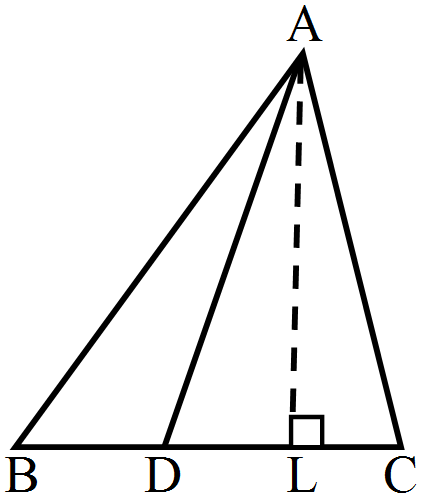
The base $BC$ of $\triangle\text{ABC}$ is divided at $D$ such that $\text{BD}=\frac{1}{2}\text{DC}.$ Prove that $\text{ar}(\triangle\text{ABD})=\frac{1}{3}\times\text{ar}(\triangle\text{ABC}).$
Answer


Given: $D$ is a point on $BC$ of $\triangle\text{ABC},$ such that $\text{BD}=\frac{1}{2}\text{DC}$
To prove: $\text{ar}(\triangle\text{ABD})=\frac{1}{3}\times\text{ar}(\triangle\text{ABC}).$
Construction: Draw $\text{AL}\perp\text{BC}.$
Proof: In $\triangle\text{ABC},$
we have: $BC = BD + DC \Rightarrow BD + 2BD = 3 \times BD$
Now, we have: $\text{ar}(\triangle\text{ABD})=\frac{1}{2}\times\text{BD}\times\text{AL}$
$\text{ar}(\triangle\text{ABC})=\frac{1}{2}\times\text{BC}\times\text{AL}$
$\Rightarrow\ \text{ar}(\triangle\text{ABC})=\frac{1}{2}\times3\text{BD}\times\text{AL}$
$\Rightarrow\ 3\times\Big(\frac{1}{2}\times\text{BD}\times\text{AL}\Big)$
$\Rightarrow\ \text{ar}(\triangle\text{ABC})=3\times\text{ar}(\triangle\text{ABD})$
$\therefore\ \text{ar}(\triangle\text{ABD})=\frac{1}{3}\text{ar}(\triangle\text{ABC})$

Need a full question paper?

Generate a complete, print-ready paper with questions like this in minutes — across 16+ boards, with answer keys.

Start Generating Free

Similar questions

The following table gives the distribution of $IQ's$ (intelligence quotients) of $60$ pupils of class $V$ in a school:
IQ's:
$125.5$ to $13.25$
$118$ to $125.5$
$111.5$ to $118.5$
$104.5$ to $111.5$
$97.5$ to $104.5$
$90.5$ to $97.5$
$83.5$ to $90.5$
$76.5$ to $83.5$
$69.5$ to $76$
$62.5$ to $69.5$
No. of pupils:
$1$
$3$
$4$
$6$
$10$
$12$
$15$
$5$
$3$
$1$
Draw a frequence polygon for the above data.
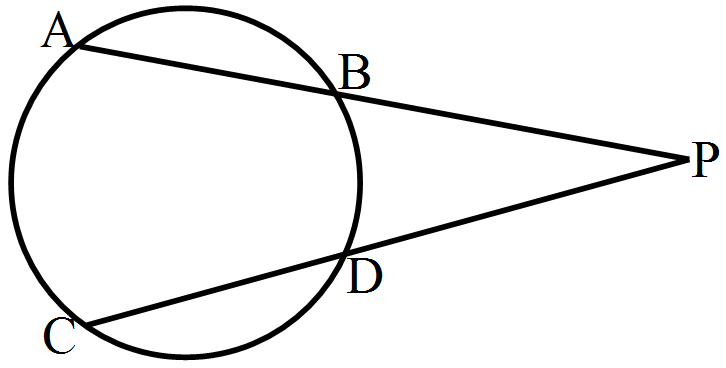
Two chords $AB$ and $CD$ of a circle intersect each other at $P$ outside the circle. If $AB = 6\ cm, BP = 2\ cm$ and $PD = 25\ cm$, find $CD$.
If $\text{x}=\frac{\sqrt{3}+\sqrt{2}}{\sqrt{3}-\sqrt{2}}$ and $\text{y}=\frac{\sqrt{3}-\sqrt{2}}{\sqrt{3}+\sqrt{2}}$ then find the value of $x^2 + y^2$.
Find rational numbers $a$ and $b$ such that: $\frac{5+2\sqrt{3}}{7+4\sqrt{3}}=\text{a}+\text{b}\sqrt{3}$
In a cyclic quadrilateral $ABCD$, if $(\angle\text{B}-\angle\text{D})=60^\circ,$ show that the smaller of the two is $60^\circ$
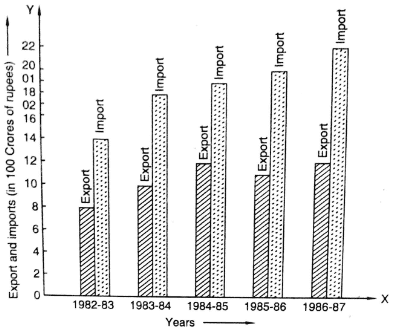
Read the following bar graph and answer the following questions:
$i.$ What information is given by the bar graph?
$ii.$ In which year the export is minimum?
$iii.$ In which year the import is maximum?
$iv.$ In which year the difference of the values of export and import is maximum?
The image of an object placed at a point A before a plane mirror $LM$ is seen at the point B by an observer at $D$ as shown in figure. Prove that the image is as far behind the mirror as the object is in front of the mirror.
In the following, using the remainder theorem, find the remainder when $f(x)$ is divided by $g(x)$ and verify the by actual division: $f(x) = 9x^3 - 3x^2 + x - 5$, $\text{g(x)}=\text{x}-\frac{2}{3}$
Evaluate:$ (28)^3 + (-15)^3 + (-13)^3$​​​​​​​