MCQ
The battery connections required to forward bias a pn junction are ____________:
- A+ve terminal to p and -ve terminal to n
- B-ve terminal to p and +ve terminal to n
- C-ve terminal to p and -ve terminal to n
- DNone of these
Explanation:
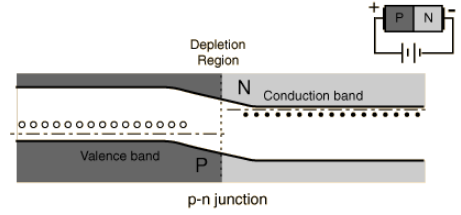
To forward bias the p-n junction, the p side is made more positive, so that it is "downhill" for electron motion across the junction. An electron can move across the junction and fill a vacancy or "hole" near the junction. It can then move from vacancy to vacancy leftward toward the positive terminal, which could be described as the hole moving right. The conduction direction for electrons in the diagram is right to left, and the upward direction represents increasing electron energy.
Generate a complete, print-ready paper with questions like this in minutes — across 16+ boards, with answer keys.
In Young's double slit experiment using sodium light (λ = 5898 Å), 92 fringes are seen. If given colour (λ = 5461 Å) is used, how many fringes will be seen
|
(a) 62 |
(b) 67 |
(c) 85 |
(d) 99 |
'Mirage' is a phenomenon due to
|
(a) Reflection of light |
(b) Refraction of light |
|
(c) Total internal reflection of light |
(d) Diffraction of light |
In the uranium radioactive series, the initial nucleus is  and the final nucleus is
  . When the uranium nucleus decays to lead, the number of α - particles emitted will be
|
(a) 1 |
(b) 2 |
(c) 4 |
(d) 8 |
According to Bohr's model, the radius of the second orbit of helium atom is
|
(a) 0.53 Å |
(b) 1.06 Å |
(c) 2.12 Å |
(d) 0.265 Å |
Two concave lenses L1 and L2 are kept in contact with each other. If the space between the two lenses is filled with a material of refractive index $\mu\approx1,$ the magnitude of the focal length of the combination:
A wire of diameter 0.02 metre contains 1028 free electrons per cubic metre. For an electrical current of 100 A, the drift velocity of the free electrons in the wire is nearly
|
(a) 1 × 10–19 m/s |
(b) 5 × 10⁻¹⁰ m/s |
(c) 2 × 10⁻⁴ m/s |
(d) 8 ×10³ m/s |