MCQ
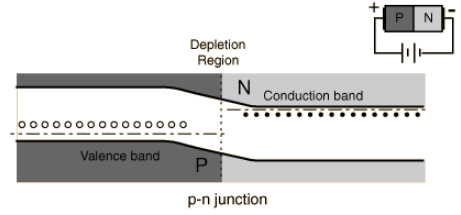
The battery connections required to forward bias a $pn$ junction are $.........$
  • $+ve$ terminal to $p$ and $-ve$ terminal to $n$
  • B
    $-ve$ terminal to $p$ and $+ve$ terminal to $n$
  • C
    $-ve$ terminal to $p$ and $-ve$ terminal to $n$
  • D
    None of these

Answer

Correct option: A.
$+ve$ terminal to $p$ and $-ve$ terminal to $n$
To forward bias the $p-n$ junction, the $p$ side is made more positive, so that it is "downhill" for electron motion across the junction. An electron can move across the junction and fill a vacancy or "hole" near the junction. It can then move from vacancy to vacancy leftward toward the positive terminal, which could be described as the hole moving right. The conduction direction for electrons in the diagram is right to left, and the upward direction represents increasing electron energy.

Need a full question paper?

Generate a complete, print-ready paper with questions like this in minutes — across 16+ boards, with answer keys.

Start Generating Free

Similar questions

A current of $5\, A$ passes through a copper conductor (resistivity $= 1.7\times10^{-8}\,\Omega \,m$) of radius of cross-section $5\, mm$. Find the mobility of the charges if their drift velocity is $1.1\times10^{-3}\, m/s$ ................ $m^2/Vs$
The reading of an ideal voltmer in the circuit shown is.....$V$
Four charges are kept at the corner points of a square. The net force on a charge kept at the center of the square is $........$?
Assertion : In series $LCR$ circuit resonance can take place.

Reason : Resonance takes place if inductance and capacitive reactances are equal and opposite.

Curies law can be written as
An atom of mass number 15 and atomic number 7 captures an α - particle and then emits a proton. The mass number and atomic number of the resulting product will respectively be
A neutron collides head-on with a stationary hydrogen atom in ground state. Which of the following statements are correct (Assume that the hydrogen atom and neutron has same mass) :
In the case of constants $\alpha$ and $\beta$ of a transistor
Is the ionisation energy of an isolated free atom different from the ionisation energy Eg for the atoms in a crystalline lattice
The emission series of hydrogen atom is given by $\frac{1}{\lambda}=R\left(\frac{1}{n_{1}^{2}}-\frac{1}{n_{2}^{2}}\right)$ where, $R$ is the Rydberg constant. For a transition from $n_{2}$ to $n_{1}$, the relative change $\Delta \lambda / \lambda$ in the emission wavelength, if hydrogen is replaced by deuterium (assume that, the mass of proton and neutron are the same and approximately $2000$ times larger than that of electrons) is ........... $\%$