Question
The bells of a temple are big in size. Why?

Answer

According to the study of bells (called campanology), larger bells provide less resonant frequency.

For a sound wave to travel long distances, it is essential that the frequency of the sound is less.

Also, it is observed that thicker the body of a bell, richer is the quality of sound.

This is the reason the bells of a temple are big in size.

Need a full question paper?

Generate a complete, print-ready paper with questions like this in minutes — across 16+ boards, with answer keys.
Start Generating Free

Similar questions

A man weighing $700 \ N$ runs up a flight of $15$ steps, each $20 \ cm$ high, in $5$ seconds. Calculate the power of the man.
Draw a ray diagram to show the appearance of a stick partially immersed in water explain your answer.
If the power of a motor is 40 KW, at what speed can it raise a load of 20,000 N?
(a) Draw a sketch to show how a lens is able to produce an image of the sun on a paper screen.
(b)(i) Would you regard the rays from the sun as being divergent, parallel or convergent?
(ii) What is the name given to the point where such rays meet after they have passed through the lens?
(iii) How does the image of the sun sometimes burn a paper screen?
Draw diagram of a three pin socket outlet and state the connections made to them.
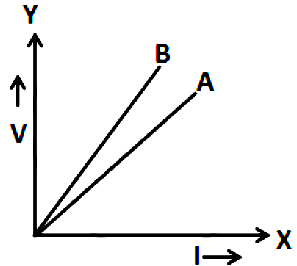
The V-I graph for a series combination and for a parallel combination of two resistors is shown in the figure below. Which of the two A or B. represents the parallel combination? Give reasons for your answer.
The input and output voltage of a transformer are 220 V and 44 V respectively. Find: the turns ratio.
A ball of mass $0.5 kg$ slows down from a speed of $5 m / s ^{-1}$ to that of $3 m / s ^{-1}$. Calculate the change in kinetic energy of the ball.
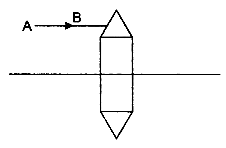
The diagram showed a lens as a combination of one glass block and two prisms. Complete the ray diagram and show the part of the incident ray AB after passing through the lens.
(i) Name of the lens formed by the combination.
(ii) What is the line XX’ called?
(iii) Mark the focus F.
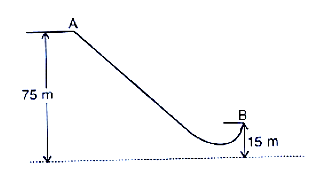
The diagram given below shows a ski jump. A skier weighing $60 kg$ stands at A at the top of ski jump. He moves from A to B and takes off for his jump at $B$.


(a) Calculate the change in the gravitational potential energy of the skier between $A$ and $B$.
(b) If $75 \%$ of the energy in part (a) becomes kinetic energy at B. Calculate the speed at which the skier arrives at B.
(Take $g =10 m s ^{-2}$ )