Question
The below diagram represents the human brain as seen in an external view. Study the same and then answer the questions that follow:
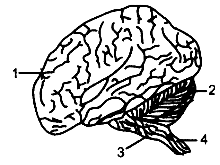
(i) Name the parts labeled 1, 2, 3, and 4.
(ii) Mention the difference in the arrangement of the nerve cells in the parts marked ‘1’ and ‘4’.
(iii) What is the main function of the parts marked ‘3’ and ‘4’?
(iv) Name the sheet of nerve fibers that connect the two halves of the part labeled ‘1’.
Answer

(i)
1. Cerebrum,
2. Cerebellum,
3. Medulla oblongata,
4. Spinal cord.

(ii)
1. Gray matter is outside and white matter inside.
4. White matter s outside and gray matter is inside.

(iii)
3. Medulla oblongata controls all involuntary movements of internal organs e.g., breathing movements of lungs, beating of the heart.
4. The spinal cord performs reflex action below the neck.

(iv) Corpus callosum.

Need a full question paper?

Generate a complete, print-ready paper with questions like this in minutes — across 16+ boards, with answer keys.

Start Generating Free

Similar questions

Differentiate between
Hormone and Enzyme
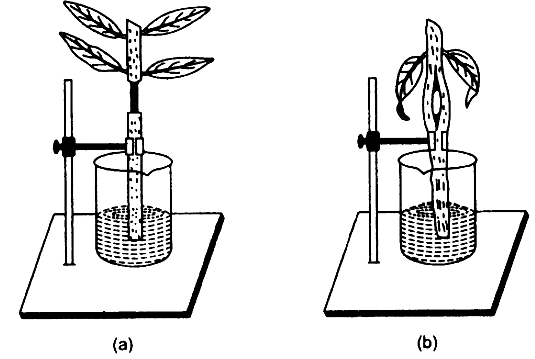
The diagram given below represents the result of an experiment conducted on two freshly taken shoots of a green herbaceous plant. The lower ends dip in the water.

(i) What is the aim of the experiment?
(ii) Some parts of the stem in both the shoots have been removed. Name the conducting tissue in shoot A and in shoot B, that has been removed.
(iii) What are the results of this experiment?
Differentiate between:
Photolysis and Photophosphorylation.
What is meant by positive and negative tropic movements in plants? Explain them by giving suitable examples.
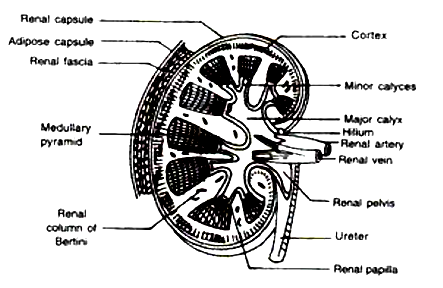
Given below is a diagram of a human kidney, cut open longitudinally. Answer the following:

(i) Give definition of excretion.
(ii) Name the unit of kidney.
(iii) Why does the cortex of kidney show dotted appearance?
(iv) List the functions of the kidney.
Differentiate between:
Open circulatory system and Closed circulatory system.
The diagram given below represents the human heart in one phase of its activity. Study the same and then answer the questions that follow:

(i) Name the phase.
(ii) Which parts of the heart are contracting in this phase ? Give a reason to support your answer.
(iii) Name the part numbered 1 to 6.
(iv) What type of blood flows through the parts marked ‘1’ and ‘2’?
(v) How many valves are closed in this phase?
The figure below represents the vertical section of a leaf:

(i) Name the parts 1 to 5.
(ii) How many veins have been shown?
(iii) State the functions of parts 4 and 5.
Why is it necessary to place a plant in the dark before starting an experiment on photosynthesis? Explain.