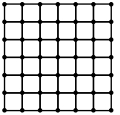
Consider the $6 \times 6$ square in the figure. Let $A_1, \mathrm{~A}_2, \ldots, A_{49}$ be the points of intersections (dots in the picture) in some order. We say that $A_i$ and $A_j$ are friends if they are adjacent along a row or along a column. Assume that each point $A_i$ has an equal chance of being chosen.
(image)
($1$) Let $p_i$ be the probability that a randomly chosen point has $i$ many friends, $i=0,1,2,3,4$. Let $X$ be a random variable such that for $i=0,1,2,3,4$, the probability $P(X=i)=p_i$. Then the value of $7 E(X)$ is
($2$) Two distinct points are chosen randomly out of the points $A_1, A_2, \ldots, A_{4 g}$. Let $p$ be the probability that they are friends. Then the value of $7 p$ is