MCQ
The binding energy per nucleon in a nucleus shows:
- ✓its stability
- Bits size
- Cits mass
- Dnone of these
Generate a complete, print-ready paper with questions like this in minutes — across 16+ boards, with answer keys.
For the post office box arrangement to determine the value of unknown resistance the unknown resistance should be connected between

|
(a) B and C |
(b) C and D |
(c) A and D |
(d) B1 and C1 |
The curve between charge density and distance near P-N junction will be
(a)

|
(b)

|
(c)

|
(d)

|
A metallic block carrying current I is subjected to a uniform magnetic induction  as shown in the figure. The moving charges experience a force
  given by ........... which results in the lowering of the potential of the face ........ Assume the speed of the carriers to be v
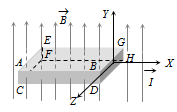
|
(a) eVB |
(b) eVB |
(c) -eVB |
(d) -eVB |
Consider the following two statements:
Photo-electric effect can be explained by
|
(a) Corpusular theory of light |
(b) Wave nature of light |
|
(c) Bohr’s theory |
(d) Quantum theory of light |
To get an output 1 from the circuit shown in the figure, the input must be

|
(a) A = 0, B = 1, C = 0 |
(b) A = 1, B = 0, C = 0 |
(c) A = 1, B = 0, C = 1 |
(d) A = 1, B = 1, C = 0 |
