The blades of a windmill sweep out a circle of area $A$. If the wind flows at a velocity $b$ perpendicular to the circle, then the mass of the air of density $\rho $ passing through it in time $t$ is
Easy
Download our app for free and get started
Volume of wind flowing per second $= Av$
Mass of wind flowing per second $= Av\rho $
Mass of air passing in time $t$ is $= Av\rho t$
Mass of wind flowing per second $= Av\rho $
Mass of air passing in time $t$ is $= Av\rho t$

Download our appand get started for free
Experience the future of education. Simply download our apps or reach out to us for more information. Let's shape the future of learning together!No signup needed.*
Similar Questions
- 1Acylindrical vessel open at the top is $20$ $cm$ high and $10$ $cm$ in diameter.Acircular hole whose cross-sectional area $1$ $cm^2$ is cut at the centre of the bottom of the vessel. Water flows from a tube above it into the vessel at the rate $100$ $cm^3s^{^{-1}}$. The height of water in the vessel under steady state is ....... $cm$ (Take $g=1000 $ $ cms^{^{-2}})$View Solution
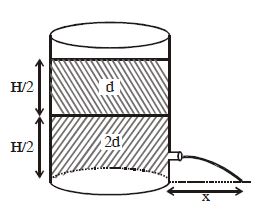
- 2A container of large uniform cross-sectional area $A$ is resting on a horizontal surface holds two immiscible, non-viscous and incompressible liquids of densities $d$ and $2d$ each of height $\frac{H}{2}$ as shown. The lower density of liquid is open to atmosphere. A small hole is made on the wall of container at height $h\left( {h < \frac{H}{2}} \right)$. The initial speed of efflux of the liquid at the hole isView Solution
- 3Suppose you have taken a dilute solution of oleic acid in such a way that its concentration becomes $0.01 \,cm ^{3}$ of oleic acid per $cm ^{3}$ of the solution. Then you make a thin film of this solution (monomolecular thickness) of area $4\, cm ^{2}$ by considering $100$ spherical drops of radius $\left(\frac{3}{40 \pi}\right)^{\frac{1}{3}} \times 10^{-3}\, cm .$ Then the thickness of oleic acid layer will be $x \times 10^{-14} \,m$. Where $x$ is ...... .View Solution
- 4Two large, identical water tanks, $1$ and $2$ , kept on the top of a building of height $H$, are filled with water up to height $h$ in each tank. Both the tanks contain an identical hole of small radius on their sides, close to their bottom. A pipe of the same internal radius as that of the hole is connected to tank $2$ , and the pipe ends at the ground level. When the water flows the tanks $1$ and $2$ through the holes, the times taken to empty the tanks are $t_1$ and $t_2$, respectively. If $H=\left(\frac{16}{9}\right) h$, then the ratio $t_1 / t_2$ is. . . . .View Solution
- 5View SolutionWhich of the following is not an assumption for an ideal fluid flow for which Bernoulli's principle is valid
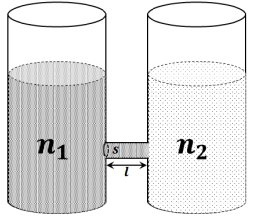
- 6As shown schematically in the figure, two vessels contain water solutions (at temperature $T$ ) of potassium permanganate $\left( KMnO _4\right)$ of different concentrations $n_1$ and $n_2\left(n_1>n_2\right)$ molecules per unit volume with $\Delta n=\left(n_1-n_2\right) \ll n_1$. When they are connected by a tube of small length $\ell$ and cross-sectional area $S , KMnO _4$ starts to diffuse from the left to the right vessel through the tube. Consider the collection of molecules to behave as dilute ideal gases and the difference in their partial pressure in the two vessels causing the diffusion. The speed $v$ of the molecules is limited by the viscous force $-\beta v$ on each molecule, where $\beta$ is a constant. Neglecting all terms of the order $(\Delta n)^2$, which of the following is/are correct? ( $k_B$ is the Boltzmann constant)-View Solution
$(A)$ the force causing the molecules to move across the tube is $\Delta n k_B T S$
$(B)$ force balance implies $n_1 \beta v \ell=\Delta n k_B T$
$(C)$ total number of molecules going across the tube per sec is $\left(\frac{\Delta n}{\ell}\right)\left(\frac{k_B T}{\beta}\right) S$
$(D)$ rate of molecules getting transferred through the tube does not change with time
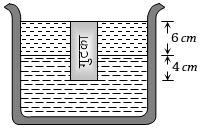
- 7A cubical block of wood $10 \,cm$ on a side floats at the interface between oil and water with its lower surface horizontal and $4\, cm$ below the interface. The density of oil is $0.6gc{m^{ - 3}}$. The mass of block is ...... $gm$View Solution
- 8A leak proof cylinder of length $1 \;\mathrm{m},$ made of a metal which has very low coefficient of expansion is floating vertically in water at $0^{\circ} \mathrm{C}$ such that its height above the water surface is $20\; \mathrm{cm} .$ When the temperature of water is increased to $4^{\circ} \mathrm{C},$ the height of the cylinder above the water surface becomes $21 \;\mathrm{cm} .$ The density of water at $\mathrm{T}=4^{\circ} \mathrm{C},$ relative to the density at $\mathrm{T}=0^{\circ} \mathrm{C}$ is close toView Solution
- 9A Spherical ball of radius $1 mm$ and density $10.5 g / cc$ is dropped in glycerine of coefficient of viscosity $9.8$ poise and density $1.5 g / cc$. Viscous force on the ball when it attains constant velocity is $3696 \times 10^{-x} N$. The value of $x$ is $\text { (Given, } g =9.8 m / s ^2 \text { and } \pi=\frac{22}{7} \text { ) }$View Solution
- 10Two water pipes $P$ and $Q$ having diameters $2$$ \times 10^{-2} $ $m$ and $4$ $\times 10^{-2}$ $m$, respectively, are joined in series with the main supply line of water. The velocity of water flowing in pipe $P$ isView Solution