MCQ
The body will speed up if ___________.
  • A
    Velocity and acceleration are in same direction.
  • B
    Velocity and acceleration are in opposite direction.
  • C
    Velocity and acceleration are in perpendicular direction.
  • D
    None of these.

Answer

  1. Velocity and acceleration are in same direction.

Explanation:

A body will speed up if both velocity and acceleration are in same direction. If they are in opposite directions it results in slowing down the motion. And if they are perpendicular then there will be no effect on magnitude of velocity.

Need a full question paper?

Generate a complete, print-ready paper with questions like this in minutes — across 16+ boards, with answer keys.
Start Generating Free

Similar questions

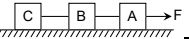
Three identical blocks of masses $m=2\; k g$ are drawn by a force $F=10.2\; N$ with an acceleration of $0.6\; ms ^{-2}$ on a frictionless surface, then what is the tension (in $N$) in the string between the blocks $B$ and $C$?
A Newtonian fluid fills the clearance between a shaft and a sleeve. When a force of $800$ $N$ is applied to the shaft, parallel to the sleeve, the shaft attains a speed of $1.5$ $cm/sec$. If a force of $2.4$ $kN$ is applied instead, the shaft would move with a speed of ......... $ cm/sec$
Two discs of same thickness but of different radii are made of two different materials such that their masses are same. The densities of the materials are in the ratio $1 : 3$.  The moments of inertia of these discs about the respective axes passing through their centres and perpendicular to their planes will be in the ratio 
$10\,gm$ of ice at $0\,^oC$ is mixed with $'m'\,gm$ of water at $50\,^oC$ . ........ $gm$ is minimum value of $m$ so that ice melts completely. ( $L_f = 80\,cal/gm$ and $S_W = 1\,cal/gm-\,^oC$ )
A ball is rolled off along the edge of a horizontal table with velocity $4 m/s$. It hits the ground after time $0.4 \,\,s$. Which of the following are correct?
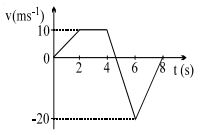
The figure shows a velocity-time graph of a particle moving along a straight line  The correct acceleration-time graph of the particle is shown as
A proton is kept at rest. A positively charged particle is released from rest at a distance d in its field. Consider two experiments one in which the charged particle is also a proton and in another, a positron. In the same time t, the work done on the two moving charged particles is:
A stone is projected from the ground with velocity $25\,m/s$. Two seconds later, it just clears a wall $5 \,m$ high. The angle of projection of the stone is ........ $^o$ $(g = 10m/{\sec ^2})$
A homogeneous cubical brick lies motionless on a rough inclined surface. The half of the brick which applies greater pressure on the plane is :
The tension in a piano wire is $10N$. What should be the tension in the wire to produce a note of double the frequency .... $N$