MCQ
The bottoms of utensils for cooking food are blackened to:
  • A
    Absorb minimum heat from fire.
  • Absorb maximum heat from fire.
  • C
    Emit radiations.
  • D
    Reflect heat to surroundings.

Answer

Correct option: B.
Absorb maximum heat from fire.

Need a full question paper?

Generate a complete, print-ready paper with questions like this in minutes — across 16+ boards, with answer keys.
Start Generating Free

Similar questions

Following forces start acting on a particle at rest at the origin of the co-ordinate system simultaneously${\overrightarrow F _1} = - 4\hat i - 5\hat j + 5\hat k$, ${\overrightarrow F _2} = 5\hat i + 8\hat j + 6\hat k$, ${\overrightarrow F _3} = - 3\hat i + 4\hat j - 7\hat k$ and ${\overrightarrow F _4} = 2\hat i - 3\hat j - 2\hat k$ then the particle will move
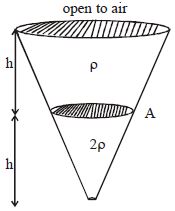
Two immiscible liquid are filled in conical flask as shown in figure. The area of cross section is shown, a small hole of area a is made in lower end of cone. Find speed of liquid flow from hole
The weight of an astronaut, in an artificial satellite revolving around the earth, is
If force $(F),$ velocity $(V)$ and time $(T)$ are taken as fundamental units, then the dimensions of mass are 
Ultrasonic, Infrasonic and audible waves travel through a medium with speeds ${V_u},\,{V_i}$ and ${V_a}$ respectively, then
A particle is tied to $20\, cm$ long string. It performs circular motion in vertical plane. What is the angular velocity of string when the tension in the string at the top is zero  ........ $rad/sec$
A sphere of relative density $\sigma$ and diameter $D$ has concentric cavity of diameter $d$. The ratio of $\frac{D}{d}$, if it just floats on water in a tank is:
The amplitude of two waves are in ratio $5 : 2$. If all other conditions for the two waves are same, then what is the ratio of their energy densities
A bucket tied at the end of a $1.6\, m$ long string is whirled in a vertical circle with constant speed. What should be the minimum speed so that the water from the bucket does not spill, when the bucket is at the highest position ........ $m/sec$ (Take $g = 10\,m/{\sec ^2}$)
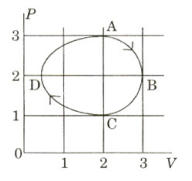
The figure shows the $P-V$ plot of an ideal gas taken through a cycle $ABCDA$. The part $ABC$ is a semi-circle and $CDA$ is half of an ellipse. Then,

$(A)$ the process during the path $\mathrm{A} \rightarrow \mathrm{B}$ is isothermal

$(B)$ heat flows out of the gas during the path $\mathrm{B} \rightarrow \mathrm{C} \rightarrow \mathrm{D}$

$(C)$ work done during the path $\mathrm{A} \rightarrow \mathrm{B} \rightarrow \mathrm{C}$ is zero

$(D)$ positive work is done by the gas in the cycle $ABCDA$