The breaking stress of aluminium is $7.5 \times 10^7 \,Nm ^{-2}$. The greatest length of aluminium wire that can hang vertically without breaking is $......... \times 10^3 \,m ($Density of aluminium is $2.7 \times 10^3 \,kg m ^{-3} )$
Medium
Download our app for free and get started
Breaking stress $=\rho \times g \times L$
Substitute values from the question
Breaking stress $=7.5 \times 10^7 \,Nm ^{-2}$
$\left\{\begin{array}{l}\rho=\text { Density of material } \\ g=\text { Acceleration due to gravity } \\ L=\text { Length of wire that can hang without breaking }\end{array}\right\}$
$\rho=2.7 \times 10^3 \,kg m ^{-3}$
$g=9.8 \,m / s$
$7.5 \times 10^7$
$=2.7 \times 10^3 \times 9.8 \times L$
Substitute values from the question
Breaking stress $=7.5 \times 10^7 \,Nm ^{-2}$
$\left\{\begin{array}{l}\rho=\text { Density of material } \\ g=\text { Acceleration due to gravity } \\ L=\text { Length of wire that can hang without breaking }\end{array}\right\}$
$\rho=2.7 \times 10^3 \,kg m ^{-3}$
$g=9.8 \,m / s$
$7.5 \times 10^7$
$=2.7 \times 10^3 \times 9.8 \times L$

Download our appand get started for free
Experience the future of education. Simply download our apps or reach out to us for more information. Let's shape the future of learning together!No signup needed.*
Similar Questions
- 1A substance breaks down by a stress of $10^6 N/m^2$. If the density of the material of the wire is $3×10^3 kg/m^3$, then the length of the wire of the substance which will break under its own weight when suspended vertically, is ......... $m$View Solution
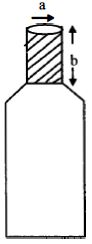
- 2A bottle has an opening of radius $a$ and length $b$. A cork of length band radius $\left( {a + \Delta a} \right)$ where $\left( {\Delta a < < a} \right)$ is compressed to fit into the opening completely (see figure). If the bulk modulus of cork is $B$ and frictional coefficient between the bottle and cork is $\mu $ then the force needed to push the cork into the bottle isView Solution
- 3A steel wire is $1 \,m$ long and $1 \,mm ^2$ in area of cross$-$section. If it takes $200 \,N$ to stretch this wire by $1 \,mm$, how much force will be required to stretch a wire of the same material as well as diameter from its normal length of $10 \,m$ to a length of $1002 \,cm$ is $........ N$View Solution
- 4The specific heat at constant pressure and at constant volume for an ideal gas are ${C_p}$ and ${C_v}$ and its adiabatic and isothermal elasticities are ${E_\varphi }$ and ${E_\theta }$ respectively. The ratio of ${E_\varphi }$ to ${E_\theta }$ isView Solution
- 5View SolutionModulus of rigidity of a liquid
- 6View SolutionYoung's modulus depends upon
- 7View SolutionAccording to Hook’s law of elasticity, if stress is increased, the ratio of stress to strain
- 8The length of an iron wire is $L$ and area of cross-section is $A$. The increase in length is $l$ on applying the force $F$ on its two ends. Which of the statement is correctView Solution
- 9If $\rho $ is the density of the material of a wire and $\sigma $ is breaking stress, the greatest length of the wire that can hang freely without breaking isView Solution
- 10Find the depth of lake at which density of water is $1\%$ greater than at the surface. Given compressibility ........... $km$ . $K = 50\times10^{-6}/atm$ ?View Solution