MCQ
Young's modulus depends upon
  • A
    Stress applied on material
  • B
    Strain produced in material
  • Temperature of material
  • D
    All of these

Answer

Correct option: C.
Temperature of material
c
(c)

Young's modulus is a material property and it also depends on temperature of material.

Need a full question paper?

Generate a complete, print-ready paper with questions like this in minutes — across 16+ boards, with answer keys.
Start Generating Free

Similar questions

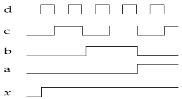
If $a,\, b,\,c,\,d$ are inputs to a gate and $x$ is its output, then, as per the following time graph, the gate is
A solid conducting sphere, having a charge $Q$, is surrounded by an uncharged conducting hollow spherical shell. Let the potential difference between the surface of the solid sphere and that of the outer surface of the hollow shell be $V$. If the shell is now given a charge of $-4\, Q$, the new potential difference between the same two surface is......$V$
Which of the following formulae is wrong
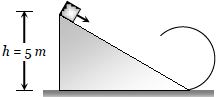
As per given figure to complete the circular loop what should be the radius if initial height is $5 \,m$ .......... $m$.
Two coils of self inductance $L _{1}$ and $L _{2}$ are connected in series combination having mutual inductance of the coils as $M$. The equivalent self inductance of the combination will be ...............
$4200\, J$ of work is required for
A simple pendulum, made of a string of length $l$ and a bob of mass $m$ , is released from a small angle $\theta_0$. It strikes a block of mass $M$, kept on a horizontal surface at its lowest point of oscillations, elastically. It bounces back and goes up to an angle $\theta_1$. Then $M$ is given by
In the double slit experiment when a glass plate (refractive index $1.5$) of thickness $t$ is introduced in the path of one of the interfering beams (wavelength $\lambda $), intensity at the position where the central maximum occurred previously remains unchanged. Minimum thickness of the glass plate is
A radioactive sample at any instant has its disintegration rate $5000$ disintegration per minute. After $5$ minutes, the rate is $1250$ disintegrations per minute. Then, the decay constant (per minute) is
If the focal length of objective lens is increased then magnifying power of