MCQ
The Bulk Modulus for an incompressible liquid is
  • A
    zero
  • B
    unity
  • infinity
  • D
    between $0$ and $1$

Answer

Correct option: C.
infinity
c
We know that the bulk modulus is,

$\mathrm{B}=-\frac{\mathrm{dpV}}{\Delta \mathrm{V}}$

Here $\mathrm{p}=$ Pressure (stress)

$-\frac{\Delta \mathrm{V}}{\mathrm{V}}=\text { Volume strain }$

But liquid is incompressible, so

${\Delta \mathrm{V}=0} $

Hence,  ${\mathrm{B}=-\frac{\mathrm{pV}}{0}=\infty}$

or $\mathrm{B}=\infty$ (infinity)

Need a full question paper?

Generate a complete, print-ready paper with questions like this in minutes — across 16+ boards, with answer keys.
Start Generating Free

Similar questions

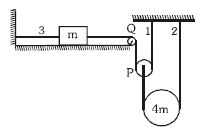
Shown in the diagram is a system of two bodies, a block of mass $m$ and a disc of mass $4\ m$ , held in equilibrium. If the string $3$ is burnt, find the acceleration of the disc. Neglect the masses of the pulleys $P$ and $Q$ . The co-efficient of friction between the block and horizontal surface is $0.5$ and friction between disc and string is zero ........ $m/s^2$
A particle of mass $m$ starts moving from origin along $x$-axis and its velocity varies with position $(x)$ as $v=k \sqrt{x}$. The work done by force acting on it during first " $t$ " seconds is ...........
A rocket with a lift- off mass $3.5 \times {10^4}$$kg$ is blasted upwards with an initial acceleration of $10m/{s^2}.$ Then the initial thrust of the blast is
The velocity of a small ball of mass $0.3\,g$ and density $8\,g / cc$ when dropped in a container filled with glycerine becomes constant after some time. If the density of glycerine is $1.3\,g / cc$, then the value of viscous force acting on the ball will be $x \times 10^{-4}\,N$, the value of $x$ is [use $g=10\,m / s ^{2}$ ] 
The component of a vector r along X-axis will have maximum value if
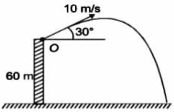
A ball is projected from a point $O$ as shown in figure. It will strike the ground after ........ $s$ $\left(g=10 \,m / s ^2\right)$
The distance of centre of mass from end $A$ of a one dimensional rod $( AB )$ having mass density $\rho=\rho_{0}\left(1-\frac{ x ^{2}}{ L ^{2}}\right)\,kg / m$ and length $L$ (in meter) is $\frac{3 L }{\alpha} m$. The value of $\alpha$ is $\ldots \ldots \ldots . .$ (where $x$ is the distance form end $A$ )
Which of the following is true about the angular momentum of a cylinder down a slope without slipping
Efficiency of an engine is $\eta_1$ at $\text{T}_1=200^\circ\text{C}$ and $\text{T}_2=0^\circ\text{C}$ and for $\eta_2$ at $\text{T}_1=0^\circ\text{C}$ and $\text{T}_2=-200\text{K},$ the ratio of $\frac{\eta_1}{\eta_2}$ is:
A string of length $0.4\, m$ and mass ${10^{ - 2}}\,kg$ is tightly clamped at its ends. The tension in the string is $1.6\, N.$ Identical wave pulses are produced at one end at equal intervals of time $\Delta t$. The minimum value of $\Delta t$ which allows constructive interference between successive pulses is  .... $s$