MCQ
The bulk modulus of an ideal gas at constant temperature
- AIs equal to its volume $V$
- BIs equal to $p/2$
- ✓Is equal to its pressure $p$
- DCan not be determined
Generate a complete, print-ready paper with questions like this in minutes — across 16+ boards, with answer keys.
where $X = \frac{{{A^2}{B^{\frac{1}{2}}}}}{{{C^{\frac{1}{3}}}{D^3}}}$, will be
$1.$ If the total energy of the particle is $E$, it will perform periodic motion only if
$(A)$ $E$ $<0$ $(B)$ $E$ $>0$ $(C)$ $\mathrm{V}_0 > \mathrm{E}>0$ $(D)$ $E > V_0$
$2.$ For periodic motion of small amplitude $\mathrm{A}$, the time period $\mathrm{T}$ of this particle is proportional to
$(A)$ $\mathrm{A} \sqrt{\frac{\mathrm{m}}{\alpha}}$ $(B)$ $\frac{1}{\mathrm{~A}} \sqrt{\frac{\mathrm{m}}{\alpha}}$ $(C)$ $\mathrm{A} \sqrt{\frac{\alpha}{\mathrm{m}}}$ $(D)$ $\mathrm{A} \sqrt{\frac{\alpha}{\mathrm{m}}}$
$3.$ The acceleration of this particle for $|\mathrm{x}|>\mathrm{X}_0$ is
$(A)$ proportional to $\mathrm{V}_0$
$(B)$ proportional to $\frac{\mathrm{V}_0}{\mathrm{mX}_0}$
$(C)$ proportional to $\sqrt{\frac{\mathrm{V}_0}{\mathrm{mX}_0}}$
$(D)$ zero
Give the answer qustion $1,2$ and $3.$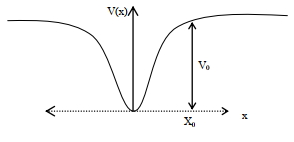
$Statement$ $(I)$ : Planck's constant and angular momentum have same dimensions.
$Statement$ $(II)$ : Linear momentum and moment of force have same dimensions.
In the light of the above statements, choose the correct answer from the options given below :