The capacitance of a metallic sphere will be $1\,\mu F$, if its radius is nearly
Easy
Download our app for free and get started
(a) $4\pi {\varepsilon _0}r = 1 \times {10^{ - 6}}$ $ = = > $ $r = {10^{ - 6}} \times 9 \times {10^9} = 9\,km$

Download our appand get started for free
Experience the future of education. Simply download our apps or reach out to us for more information. Let's shape the future of learning together!No signup needed.*
Similar Questions
- 1View SolutionThe outer sphere of a spherical air capacitor is earthed. For increasing its capacitance
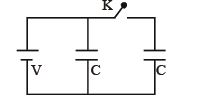
- 2Consider the arrangement shown in figure. The total energy stored is $U_1$ when key is closed. Now the key $K$ is made off (opened) and two dielectric slabs of relative permittivity ${ \in _r}$ are introduced between the plates of the two capacitors. The slab tightly fit in between the plates. The total energy stored is now $U_2$. Then the ratio of $U_1/U_2$ isView Solution
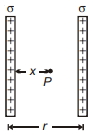
- 3For two infinitely long charged parallel sheets, the electric field at $P$ will beView Solution
- 4The energy stored in a condenser of capacity $C$ which has been raised to a potential $V$ is given byView Solution
- 5A thin-walled, spherical conducting shell $S$ of radius $R$ is given charge $Q$. The same amount of charge is also placed at its centre $C. $ Which of the following statements are correct ?View Solution
- 6If $q$ is the charge per unit area on the surface of a conductor, then the electric field intensity at a point on the surface isView Solution
- 7Charge $q_{2}$ is at the centre of a circular path with radius $r$. Work done in carrying charge $q_{1}$, once around this equipotential path, would beView Solution
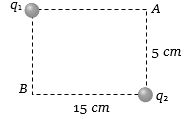
- 8$n$ the rectangle, shown below, the two corners have charges ${q_1} = - 5\,\mu C$ and ${q_2} = + 2.0\,\mu C$. The work done in moving a charge $ + 3.0\,\mu C$ from $B$ to $A$ is.........$J$ $(1/4\pi {\varepsilon _0} = {10^{10}}\,N{\rm{ - }}{m^2}/{C^2})$View Solution
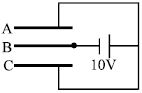
- 9Three plates $A, B$ and $C$ each of area $0.1 \ m^2$ are separated by $0.885\ mm$ from each other as shown in the figure. $A$ $10$ $V$ battery is used to charge the system. The energy stored in the system isView Solution
- 10The electric field between the plates of a parallel plate capacitor when connected to a certain battery is ${E_0}$. If the space between the plates of the capacitor is filled by introducing a material of dielectric constant $K$ without disturbing the battery connections, the field between the plates shall beView Solution