Charge $q_{2}$ is at the centre of a circular path with radius $r$. Work done in carrying charge $q_{1}$, once around this equipotential path, would be
AIPMT 1994, Easy


Download our appand get started for free
Experience the future of education. Simply download our apps or reach out to us for more information. Let's shape the future of learning together!No signup needed.*
Similar Questions
- 1View SolutionAssertion : Two equipotential surfaces cannot cut each other.
Reason : Two equipotential surfaces are parallel to each other.
- 2Two parallel plate capacitors $C_1$ and $C_2$ each having capacitance of $10 \mu F$ are individually charged by a $100\,V$ $D.C.$ source. Capacitor $C _1$ is kept connected to the source and a dielectric slab is inserted between it plates. Capacitor $C _2$ is disconnected from the source and then a dielectric slab is inserted in it. Afterwards the capacitor $C_1$ is also disconnected from the source and the two capacitors are finally connected in parallel combination. The common potential of the combination will be $.........V.$ (Assuming Dielectric constant $=10$ )View Solution
- 3The distance between the two plates of a parallel plate capacitor is doubled and the area of each plate is halved. If $C$ is its initial capacitance, its final capacitance is equal toView Solution
- 4In figure a system of four capacitors connected across a $10\, V$ battery is shown. Charge that will flow from switch $S$ when it is closed isView Solution
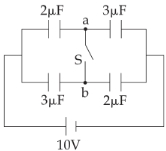
- 5A cylindrical capacitor has two co-axial cylinders of length $20 \,cm$ and radii $2 r$ and $r$. Inner cylinder is given a charge $10 \,\mu C$ and outer cylinder a charge of $-10 \,\mu C$. The potential difference between the two cylinders will beView Solution
- 6View SolutionNo current flows between two charged bodies connected together when they have the same
- 7The work which is required to be done to make an arrangement of four particles each having a charge $+q$ such that the particles lie at the four corners of a square of side $a$ is .......View Solution
- 8View SolutionWhen a parallel plates capacitor is connected to a source of constant potential difference,
- 9$n$ identical condensers are joined in parallel and are charged to potential $V$. Now they are separated and joined in series. Then the total energy and potential difference of the combination will beView Solution
- 10The capacitance of a parallel plate capacitor is $5\, \mu F$ . When a glass slab of thickness equal to the separation between the plates is introduced between the plates, the potential difference reduces to $1/8$ of the original value. The dielectric constant of glass isView Solution