The capacitance of a parallel plate capacitor is $12\,\mu \,F$. If the distance between the plates is doubled and area is halved, then new capacitance will be.........$\mu \,F$
Easy
Download our app for free and get started
(d) $C = \frac{{{\varepsilon _0}A}}{d}$ As $A \to \frac{1}{2}$ times and $d \to 2$ times
So $C \to \frac{1}{4}$times i.e. $C' = \frac{1}{4}C = \frac{{12}}{4} = 3\,\mu F$
So $C \to \frac{1}{4}$times i.e. $C' = \frac{1}{4}C = \frac{{12}}{4} = 3\,\mu F$

Download our appand get started for free
Experience the future of education. Simply download our apps or reach out to us for more information. Let's shape the future of learning together!No signup needed.*
Similar Questions
- 1A proton of mass $m$ and charge $e$ is projected from a very large distance towards an $\alpha$-particle with velocity $v$. Initially $\alpha$-particle is at rest, but it is free to move. If gravity is neglected, then the minimum separation along the straight line of their motion will beView Solution
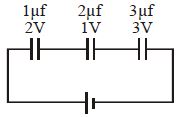
- 2The diagram shows three capacitors with their capacitances and with breakdown voltages. What should be the maximum value of external $emf$ of source such that no capacitor breaks downView Solution
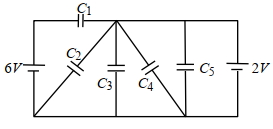
- 3In the following circuit $C_1=12 \mu F, C_2=C_3=4 \mu F$ and $C_4=C_5=2 \mu F$. The Charge stored in $C_3$ is. . . . . $\mu C$.View Solution
- 4The electric field near a conducting surface having a uniform surface charge density $\sigma $ is given byView Solution
- 5A capacitor with capacitance $5\,\mu F$ is charged to $5\,\mu C.$ If the plates are pulled apart to reduce the capacitance to $2\,\mu F,$ how much work is done?View Solution
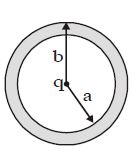
- 6In the figure shown the electric potential energy of the system is: ( $q$ is at the centre of the conducting neutral spherical shell of inner radius $a$ and outer radius $b$ )View Solution
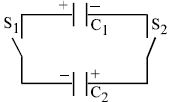
- 7Two capacitors $C_1 = 4\ \mu F$ and $C_2 = 2\ \mu F$ are charged to same potential $ V = 500\ Volt$, but with opposite polarity as shown in the figure. The switches $S_1$ and $S_2$ are closed.View Solution
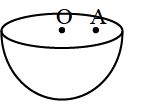
- 8Charge is uniformly distributed on the surface of a hollow hemisphere. Let $O$ and $A$ be two points on the base of the hemisphere and $V_0$ and $V_A$ be the electric potentials at $O$ and $A$ respectively. Then,View Solution
- 9A parallel plate capacitor of capacitance $90\ pF$ is connected to a battery of $emf$ $20\ V$. If a dielectric material of dielectric constant $K = \frac{5}{3}$ is inserted between the plates, the magnitude of the induced charge will be.......$n $ $C$View Solution
- 10A solid sphere of radius $R$ is charged uniformly. At what distance from its surface is the electrostatic potential half of the potential at the centre?View Solution