MCQ
The capacitance of a parallel plate condenser does not depend on
  • A
    Area of the plates
  • B
    Medium between the plates
  • C
    Distance between the plates
  • Metal of the plates

Answer

Correct option: D.
Metal of the plates
d
Formula used

capacitance $c=\frac{q}{v}$

capacitance of a parallel plate capacitor is given as

$c=\frac{k \varepsilon_0 A}{d}$

The capacitance of the condensor does not depend upon metal of the plates

Need a full question paper?

Generate a complete, print-ready paper with questions like this in minutes — across 16+ boards, with answer keys.

Start Generating Free

Similar questions

Which logic gate is represented by following diagram
Magnetic dipole moment of a rectangular loop is
When a ray of light emerges from a block of glass, the critical angle is
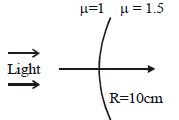
What is the focal length of this curved surface ?........$cm$
If $m$ is mass of $_Z{X^A}$  nucleus , $m_n$ and $m_p$ are the masses of neutron and proton respectively so.......
A capacitor with capacitance $5\,\mu F$ is charged to $5\,\mu C.$ If the plates are pulled apart to reduce the capacitance to $2\,\mu F,$ how much work is done?
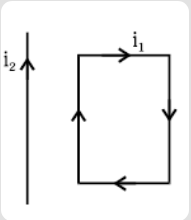
A rectangular loop carrying a current $i_1$, is situated near a long straight wire carrying a steady current $i_2$​. The wire is parallel to one of the sides of the loop and is in the plane of the loop as shown in the figure. Then the current loop will:
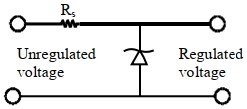
A zener diode of power rating $1.6\,W$ is to be used as voltage regulator. If the zener diode has a breakdown of $8\,V$ and it has to regulate voltage fluctuating between $3\,V$ and $10 \,V$. The value of resistance $R_5$ for safe operation of diode will be $.........\Omega$
A beam of light travelling along $X$-axis is described by the electric field $E _{ y }=900 \sin \omega( t - x / c )$. The ratio of electric force to magnetic force on a charge $q$ moving along $Y$-axis with a speed of $3 \times 10^{7}\,ms ^{-1}$ will be.

[Given speed of light $=3 \times 10^{8}\,ms ^{-1}$ ]

For using a multimeter to identify diode from electrical components. choose the correct statement out of the following about the diode