MCQ
The capacitance of the capacitor is given by:
- AC = Q/V.
- BC = V/Q.
- CC = QV.
- DQ = C/V
Generate a complete, print-ready paper with questions like this in minutes — across 16+ boards, with answer keys.
Which of the following transitions in a hydrogen atom emits photon of the highest frequency
|
(a) n = 1 to n = 2 |
(b) n = 2 to n = 1 |
(c) n = 2 to n = 6 |
(d) n = 6 to n = 2 |
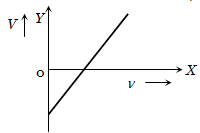
The stopping potential V for photoelectric emission from a metal surface is plotted along Y-axis and frequency n of incident light along X-axis. A straight line is obtained as shown. Planck's constant is given by
|
(a) Slope of the line |
|
(b) Product of slope on the line and charge on the electron |
|
(c) Product of intercept along Y-axis and mass of the electron |
|
(d) Product of Slope and mass of electron |
In the circuit shown, the value of each resistance is r, then equivalent resistance of circuit between points A and B will be

|
(a) (4/3) r |
(b) 3r / 2 |
(c) r / 3 |
(d) 8r/7 |
The ratio activity of an element becomes 1/64th of its original value in 60 sec. Then the half life period is
|
(a) 5 sec |
(b) 10 sec |
(c) 20 sec |
(d) 30 sec |
Assertion : A narrow pulse of light is sent through a medium. The pulse will retain its shape as it travels through the medium.
Reason : A narrow pulse is made of harmonic waves with a large range of wavelengths.
|
(a) If both assertion and reason are true and the reason is the correct explanation of the assertion. |
|
(b) If both assertion and reason are true but reason is not the correct explanation of the assertion. |
|
(c) If assertion is true but reason is false. |
|
(d) If assertion is false but reason is true. |
To obtain P-type Si semiconductor, we need to dope pure Si with
|
(a) Aluminium |
(b) Phosphorous |
(c) Oxygen |
(d) Germanium |