MCQ
The capacitive reactance of $50\mu\text{F}$ capacitance at a frequency of 2 × 10³Hz will be ____ $\Omega$
- A$\frac{2}{\pi}$
- B$\frac{3}{\pi}$
- C$\frac{4}{\pi}$
- D$\frac{5}{\pi}$
Explanation:
Capacitive reactance $=\frac{1}{\omega\text{c}}$
$=\frac{1}{2\pi\text{fc}}$
$=\frac{1}{2\pi2\times10^3\times50\times10^{-6}}$
$=\frac{5}{\pi}\Omega$
Generate a complete, print-ready paper with questions like this in minutes — across 16+ boards, with answer keys.
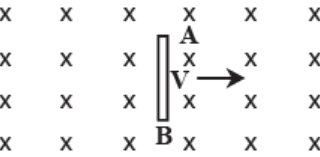
What is the time taken (in seconds) to cross a glass of thickness 4 mm and μ = 3 by light
|
(a) 4 |
(b) 2 |
(c) 16 |
(d) 8 |
The fact that electric charges are integral multiples of the fundamental electronic charge was proved experimentally by
|
(a) Planck |
(b) J.J. Thomson |
(c) Einstein |
(d) Millikan |
The energy required to knock out the electron in the third orbit of a hydrogen atom is equal to
|
(a) 13.6 eV |
(b) + |
(c) - |
(d) - |
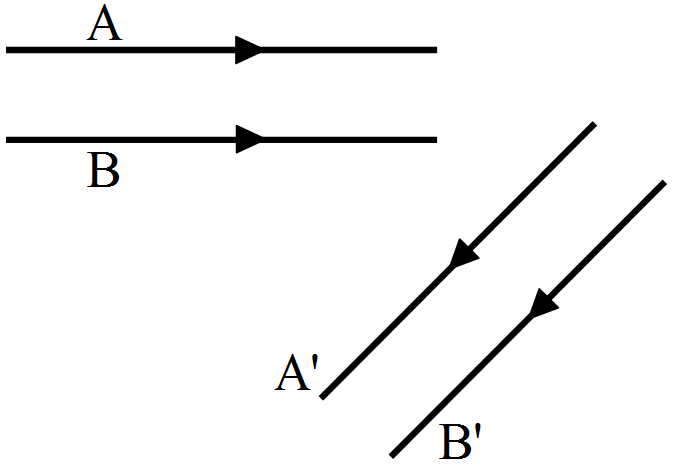
Two rays A and B being reflected by a mirror and going as A' and B'. The mirror:
When the number of turns in a coil is doubled without any change in the length of the coil, its self inductance becomes
|
(a) Four times |
(b) Doubled |
(c) Halved |
(d) Unchanged |
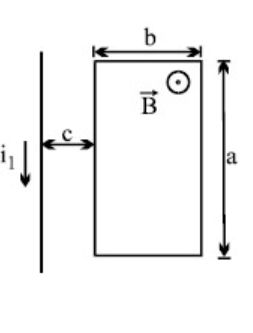
The incorrect statement regarding the lines of force of the magnetic field B is
|
(a) Magnetic intensity is a measure of lines of force passing through unit area held normal to it |
|
(b) Magnetic lines of force form a close curve |
|
(c) Inside a magnet, its magnetic lines of force move from north pole of a magnet towards its south pole |
|
(d) Due to a magnet magnetic lines of force never cut each other |


