MCQ
The capacity of a parallel plate capacitor increases with the
  • A
    Decrease of its area
  • B
    Increase of its distance
  • Increase of its area
  • D
    None of the above

Answer

Correct option: C.
Increase of its area
c
(c) Capacity of parallel plate capacitor $C = \frac{{{\varepsilon _0}A}}{d}$$ ==>$ $C$ $\propto$ $A$

Need a full question paper?

Generate a complete, print-ready paper with questions like this in minutes — across 16+ boards, with answer keys.
Start Generating Free

Similar questions

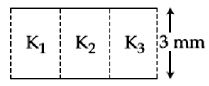
A parallel plate capacitor is of area $6\, cm^2$ and a separation $3\, mm$. The gap is filled with three dielectric materials of equal thickness (see figure) with dielectric constants $K_1 = 10, K_2 = 12$ and $K_3 = 14$. The dielectric constant of a material which when fully inserted in above capacitor, gives same capacitance would be
The splitting of line into groups under the effect of electric or magnetic field is called
Let r be the distance of a point on the axis of a magnetic dipole from its centre. The magnetic field at such a point is proportional to:
In Young's double slit experiment, the slits are 0.5 mm apart and interference pattern is observed on a screen placed at a distance of 1.0 m from the plane containing the slits. If wavelength of the incident light is 6000 Å, then the separation between the third bright fringe and the central maxima is
If a small amount of antimony is added to germanium crystal:
Consider a long, straight wire of cross-sectional area A carrying a current i. Let there be n free electrons per unit volume. An observer places himself on a trolley moving in the direction opposite to the current with a speed $\text{v}=\frac{\text{i}}{\text{nAe}}$ and separated from the wire by a distance r. The magnetic field seen by the observer is very nearly:
Monochromatic light of frequency $5 \times {10^{14}}Hz$ travelling in vacuum enters a medium of refractive index $1.5.$ Its wavelength in the medium is.......$\mathop A\limits^o $
The resistance of a galvanometer is $50 \Omega$ and the current required to give full scale deflection is $100 \mu A$. In order to convert it into an ammeter for reading up to $10 A $, it is necessary to put a resistance of
Two protons are kept at a separation of $10\ nm.$ Let $F_n$ and $F_e$ be the nuclear force and the electromagnetic force between them:
The energy liberated on complete fission of 1 kg of $92^{\mathrm{U}^{285}}$ is (Assume 200 MeV energy is liberated on fission of 1 nucleus)