The capacity of a parallel plate condenser is $10\,\mu F$ without dielectric. Dielectric of constant $2$ is used to fill half the distance between the plates, the new capacitance in $\mu F$ is
Medium


Download our appand get started for free
Experience the future of education. Simply download our apps or reach out to us for more information. Let's shape the future of learning together!No signup needed.*
Similar Questions
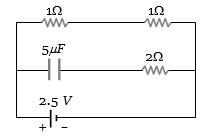
- 1A capacitor of capacitance $5\,\mu F$ is connected as shown in the figure. The internal resistance of the cell is $0.5\,\Omega $. The amount of charge on the capacitor plate is......$\mu C$View Solution
- 2There is a uniform electrostatic field in a region. The potential at various points on a small sphere centred at $P$, in the region, is found to vary between in the limits $589.0\,V$ to $589.8\, V$. What is the potential at a point on the sphere whose radius vector makes an angle of $60^o$ with the direction of the field ?........$V$View Solution
- 3Three capacitors each of $4\,\,\mu F$ are to be connected in such a way that the effective capacitance is $6\,\,\mu F.$ This can be done by connecting thernView Solution
- 4At a certain distance from a point charge the electric field is $500\,V/m$ and the potential is $3000\,V$. What is this distance......$m$View Solution
- 5A resistor '$R$' and $2\ μF$ capacitor in series is connected through a switch to $200\ V$ direct supply. Across the capacitor is a neon bulb that lights up at $120\ V$. Calculate the value of $R$ to make the bulb light up $5\ s$ after the switch has been closed. $(log_{10} 2.5 = 0.4)$.View Solution
- 6View SolutionThe potential to which a conductor is raised, depends on
- 7Two charged particles of masses $m$ and $2m$ have charges $+2q$ and $+q$ respectively. They are kept in uniform electric field and allowed to move for some time. The ratio of their kinetic energies will beView Solution
- 8Voltage rating of a parallel plate capacitor is $500\,V$. Its dielectric can withstand a maximum electric field of ${10^6}\,\frac{V}{m}$. The plate area is $10^{-4}\, m^2$ . What is the dielectric constant if the capacitance is $15\, pF$ ? (given ${ \in _0} = 8.86 \times {10^{ - 12}}\,{C^2}\,/N{m^2}$)View Solution
- 9A parallel plate capacitor of capacitance $C$ is connected to a battery and is charged to a potential difference $V$. Another capacitor of capacitance $2C$ is similarly charged to a potential difference $2V$. The charging battery is now disconnected and the capacitors are connect in parallel to each other in such a way that the positive terminal of one is connected to the negative terminal of the other. The final energy of the configuration isView Solution
- 10A $10\ \mu F$ capacitor is charged to a potential difference of $1000\ V$. The terminals of the charged capacitor are disconnected from the power supply and connected to the terminals of an uncharged $6\ \mu F$ capacitor. What is the final potential difference across each capacitor.....$V$View Solution