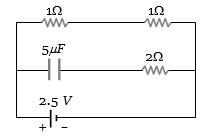
A capacitor of capacitance $5\,\mu F$ is connected as shown in the figure. The internal resistance of the cell is $0.5\,\Omega $. The amount of charge on the capacitor plate is......$\mu C$
Medium


Download our appand get started for free
Experience the future of education. Simply download our apps or reach out to us for more information. Let's shape the future of learning together!No signup needed.*
Similar Questions
- 1Three long concentric conducting cylindrical shells have radii $R, 2R$ and $2\sqrt 2 $ $ R$ . Inner and outer shells are connected to each other. The capacitance across middle and inner shells per unit length is:View Solution
- 2The variation of electrostatic potential with radial distance $r$ from the centre of a positively charged metallic thin shell of radius $R$ is given by the graphView Solution
- 3A parallel plate air capacitor has a capacitance of $100\,\mu F$. The plates are at a distance $d$ apart. If a slab of thickness $t(t \le d)$and dielectric constant $5$ is introduced between the parallel plates, then the capacitance will be.......$\mu F$View Solution
- 4A capacitor of capacitance $6\,\mu \,F$ is charged upto $100$ $volt$. The energy stored in the capacitor is........$Joule$View Solution
- 5A hollow metallic sphere of radius $10 \;cm$ is charged such that potential of its surface is $80\; V$. The potential at the centre of the sphere would beView Solution
- 6If the potential at the centre of a uniformly charged hollow sphere of radius $R$ is $V$ then electric field at a distance $r$ from the centre of the sphere is $(r > R)$View Solution
- 7A parallel plate capacitor of capacitance $C$ has spacing $d$ between two plates having area $A$. The region between the plates is filled with $N$ dielectric layers, parallel to its plates, each with thickness $\delta=\frac{ d }{ N }$. The dielectric constant of the $m ^{\text {th }}$ layer is $K _{ m }= K \left(1+\frac{ m }{ N }\right)$. For a very large $N \left(>10^3\right)$, the capacitance $C$ is $\alpha\left(\frac{ K \varepsilon_0 A }{ d \;ln 2}\right)$. The value of $\alpha$ will be. . . . . . . .View Solution
[ $\in_0$ is the permittivity of free space]
- 8View SolutionChoose the incorrect statement from the following: When two identical capacitors are charged individually to different potentials and connected parallel to each other after disconnecting them from the source
- 9A $60\; pF$ capacitor is fully charged by a $20\; \mathrm{V}$ supply. It is then disconnected from the supply and is connected to another uncharged $60 \;pF$ capactior is parallel. The electrostatic energy that is lost in this process by the time the charge is redistributed between them is (in $nJ$)View Solution
- 10The diagram shows three capacitors with their capacitances and with breakdown voltages. What should be the maximum value of external $emf$ of source such that no capacitor breaks downView Solution