MCQ
The cathode of a photoelectric cell is changed such that the work function changes from $W_1$ to $W_2\left(W_2>W_1\right)$. If the current before and after change are $\mathrm{I}_1$ and $\mathrm{I}_2$, all other conditions remaining unchanged, then (assuming $\mathrm{hn}>\mathrm{W}_2$ )
  • $I_1=I_2$
  • B
    $I_1
  • C
    $I_1>I_2$
  • D
    $I_1

Answer

Correct option: A.
$I_1=I_2$
(a) $I_1=I_2$

Need a full question paper?

Generate a complete, print-ready paper with questions like this in minutes — across 16+ boards, with answer keys.

Start Generating Free

Similar questions

According to Joule's law, if the potential difference across a conductor having a material of specific resistance remains constant, then the heat produced in the conductor is directly proportional to
An electric dipole is situated in an electric field of uniform intensity $E$ whose dipole moment is $p$ and moment of inertia is $I$. If the dipole is displaced slightly from the equilibrium position, then the angular frequency of its oscillations is
The distance of an object from the pole of a concave mirror is equal to its radius of curvature . The image must be :
A plane mirror reflects a pencil of light to form a real image. Then the pencil of light incident on the mirror is
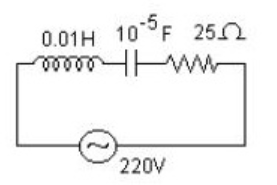
In the following circuit, the values of current flowing in the circuit at $f = 0$ and $\text{f}=\infty$ will respectively be.
Image
When $100\, volts$ $dc$ is supplied across a solenoid, a current of $1.0$ amperes flows in it. When $100 \,volts$ $ac$ is applied across the same coil, the current drops to $0.5$ ampere. If the frequency of ac source is $50 \,Hz$, then the impedance and inductance of the solenoid are
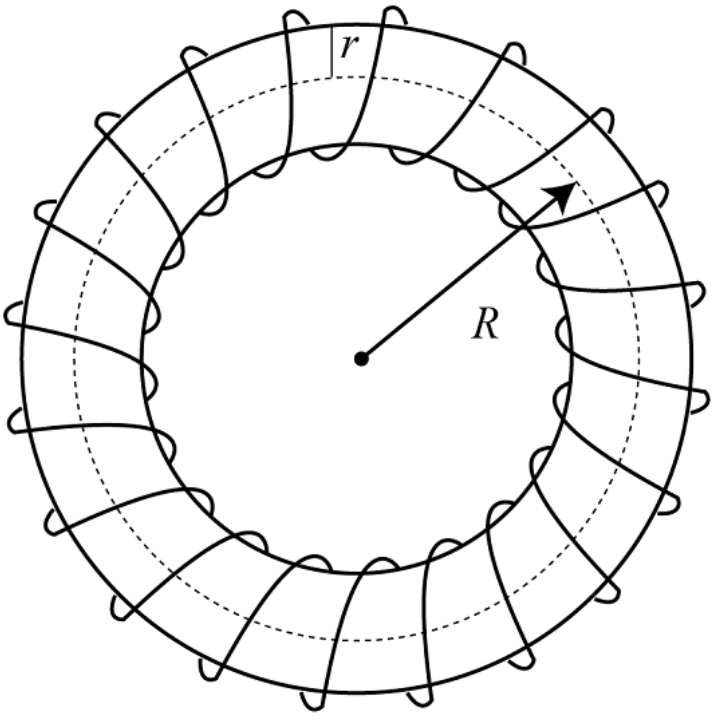
A toroid is wound over a circular core with total no. of turns equal to $N$. The radius of each turn is $r$ and radius of toroid is $R(>>r).$ The coefficient of self$-$inductance of the toroid is given by.
Image
The line on the earth's surface joining the points where the field is horizontal is
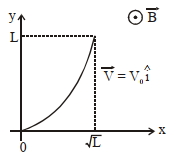
A conducting wire of parabolic shape, initially $y=x^2$, is moving with velocity $\overrightarrow{ V }= V _0 \hat{ i }$ in a nonuniform magnetic field $\vec{B}=B_0\left(1+\left(\frac{y}{L}\right)^\beta\right) \hat{k}$, as shown in figure. If $V_0, B_0, L$ and $\beta$ are positive constants and $\Delta \phi$ is the potential difference developed between the ends of the wire, then the correct statement(s) is/are:

$(1)$ $|\Delta \phi|$ remains the same if the parabolic wire is replaced by a straight wire, $y=x$ initially, of length $\sqrt{2} L$

$(2)$ $|\Delta \phi|$ is proportional to the length of the wire projected on the $y$-axis.

$(3)$ $|\Delta \phi|=\frac{1}{2} B _0 V _0 L$ for $\beta=0$

$(4)$ $|\Delta \phi|=\frac{4}{3} B_0 V_0 L$ for $\beta=2$

The three basic properties possessed by the electric charge are: