MCQ
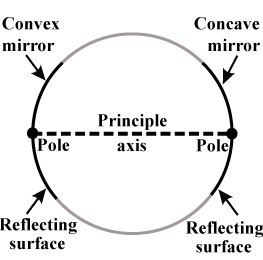
The central point of a spherical mirror is called:
- APole
- BCentre of sphere
- CCentre of curvature
- DNone of these
The central point of a spherical mirror is called:
Explanation:
The central point of a spherical mirror is called the Pole of the mirror.
Generate a complete, print-ready paper with questions like this in minutes — across 16+ boards, with answer keys.
Smaller pieces of heavy stones and metals which on entering earth's atmosphere burns out are
|
(a) Comets |
(b) Meteorites |
(c) Asteroids |
(d) All of these |
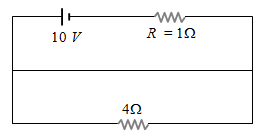
Potential difference across the terminals of the battery shown in figure is (r = internal resistance of battery)
|
(a) 8 V |
(b) 10 V |
(c) 6 V |
(d) Zero |
Between the plates of a parallel plate condenser there is 1mm thick paper of dielectric constant 4. It is charged at 100 volt. The electric field in volt/metre between the plates of the capacitor is
|
(a) 100 |
(b) 100000 |
(c) 25000 |
(d) 4000000 |
Two coherent sources separated by distance d are radiating in phase having wavelength l. A detector moves in a big circle around the two sources in the plane of the two sources. The angular position of n = 4 interference maxima is given as

|
(a) |
(b) |
(c) |
(d) |
Assertion : Ultraviolet radiation are of higher frequency waves are dangerous to human being.
Reason : Ultraviolet radiation are absorbed by the atmosphere
|
(a) If both assertion and reason are true and the reason is the correct explanation of the assertion. |
|
(b) If both assertion and reason are true but reason is not the correct explanation of the assertion. |
|
(c) If assertion is true but reason is false. |
|
(d) If the assertion and reason both are false. |


