Question
The changes in a function y and the independent dy variable x are related as $\frac{\text{dy}}{\text{dx}}=\text{x}^2.$ Find y as a function of x.

Answer

The change in a function of y and the independent variable x are related as $\frac{\text{dy}}{\text{dx}}=\text{x}^2.$$\Rightarrow\text{dy}=\text{x}^2\text{dx}$
Taking integration of both sides,$\int\text{dy}=\int\text{x}^2\text{dx}\Rightarrow\text{y}=\frac{\text{x}^3}{3}+\text{c}$
$\therefore$ y as a function of x is represented by $\text{y}=\frac{\text{x}^3}{3}+\text{c}.$

Need a full question paper?

Generate a complete, print-ready paper with questions like this in minutes — across 16+ boards, with answer keys.
Start Generating Free

Similar questions

In a double slit interference experiment, the separation between the slits is $1.0\ mm,$ the wavelength of light used is $5.0 \times 10^{-7}m$ and the distance of the screen from the slits is $1.0m$.
  1. Find the distance of the centre of the first minimum from the centre of the central maximum.
  2. How many bright fringes are formed in one centimeter width on the screen?
Explain the rules for obtaining image due to reflection from a spherical mirror.
The magnetic field inside a tightly wound, long solenoid is $\text{B}=\mu_0\text{ni}.$ It suggests that the field does not depend on the total length of the solenoid, and hence if we add more loops at the ends of a solenoid the field should not increase. Explain qualitatively why the extra-added loops do not have a considerable effect on the field inside the solenoid.
A block of mass 2kg is pushed against a rough vertical wall with a force of 40N, coefficient of static friction being 0.5. Another horizontal force of 15N, is applied on the block in a direction parallel to the wall. Will the block move? If yes, in which direction? If no, find the frictional force exerted by the wall on the block.
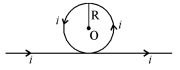
A long wire is bent as shown in the figure. Find the magnitude and direction of magnetic field at center $O$ of the circular part when a current $i$ ampere flows through it.
Image
  1. Explain the meaning of the statement ‘electric charge of a body is quantised’.
  2. Why can one ignore quantisation of electric charge when dealing with macroscopic i.e., large scale charges?
In a resonance column experiment, a tuning fork of frequency 400Hz is used. The first resonance is observed when the air column has a length of 20.0cm and the second resonance is observed when the air column has a length of 62.0cm.
  1. Find the speed of sound in air.
  2. How much distance above the open end does the pressure node form?
Explain the structure of Polaroid.
A driver takes $0.20s$ to apply the brakes after he sees a need for it. This is called the reaction time of the driver. If he is driving a car at a speed of $54\ km/h$ and the brakes cause a deceleration of $6.0m/s^2,$ find the distance travelled by the car after he sees the need to put the brakes on.
An alternating voltage of frequency $f$ is applied across a series $\text{LCR}$ circuit. Let $f_r$ be the resonance frequency for the circuit. Will the current in the circuit lag, lead or remain in phase with the applied voltage when $(i)\ f > f_r, (ii)\ f < f_r$? Explain your answer in each case.