Question
The changes in a function y and the independent dy variable x are related as $\frac{\text{dy}}{\text{dx}}=\text{x}^2.$ Find y as a function of x.

Answer

The change in a function of y and the independent variable x are related as $\frac{\text{dy}}{\text{dx}}=\text{x}^2.$
$\Rightarrow\text{dy}=\text{x}^2\text{dx}$
Taking integration of both sides,
$\int\text{dy}=\int\text{x}^2\text{dx}\Rightarrow\text{y}=\frac{\text{x}^3}{3}+\text{c}$
$\therefore$ y as a function of x is represented by $\text{y}=\frac{\text{x}^3}{3}+\text{c}.$

Need a full question paper?

Generate a complete, print-ready paper with questions like this in minutes — across 16+ boards, with answer keys.
Start Generating Free

Similar questions

Name the physical quantity corresponding to force in rotational motion. How is it related to force and give its units?
Find out when a 50 m long steel rod of 10 $c m ^2$ cross-section is heated from $0^{\circ} C$ to $50^{\circ} C$ (i) increase in length of rod (ii) if both the ends of the rod are connected to rigid supports, then the force produced in it will know thermal stress. (Given $\alpha=1.2 \times 10^{-5}{ }^{\circ} C ^{-1}$ and $\left.Y =9.6 \times 10^7 N / m ^2\right)$
When a stress of $2 \times 10^6 N / m ^2$ is applied on a copper wire ( $Y =1^{11} N / m ^2$ ), what will be the percentage increase in its length?
A classroom demonstration of Newton's first law is as follows: A glass is covered with a plastic card and a coin is placed on the card. The card is given a quick strike and the coin falls in the glass.
  1. Should the friction coefficient between the card and the coin be small or large?
  2. Should the coin be light or heavy?
  3. Why does the experiment fail if the card is gently pushed?
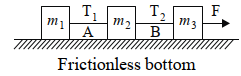
In the figure, three blocks are tied with two strings $A$ and $B . m_1=10 kg, m_2=5 kg, m_3=5 kg$. The bottom is frictionless. If $m _3$ is pulled to the right by applying a horizontal force of 50 N then calculate the tension in the strings.
Image
Define the term wave motion. Give four important characteristics of wave motion.
A balloon with hydrogen in it rises up but a balloon with air comes down, Why?
Find the area bounded by the curve y = e-x, the X-axis and the Y-axis.
Two particles of equal mass 'm' go round a circle of radius R, under the action of their mutual gravitational attraction. What is the speed of each particle?
If the initial velocity of a particle is $u$ and the acceleration in the same direction changes with time as $\alpha t$, then what will be the velocity at time $t$ ?