MCQ
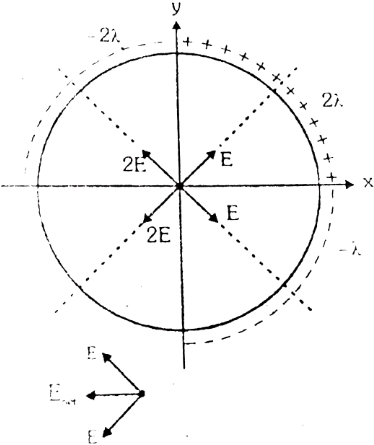
The charge per unit length of the four quadrant of the ring is $2\ \lambda , - 2\ \lambda , \lambda$ and $- \lambda$ respectively. The electric field at the centre is
  • $-$ $\frac{\lambda }{{2\pi {\varepsilon _0}R}}\,\hat i$
  • B
    $\frac{\lambda }{{2\pi {\varepsilon _0}R}}\,\hat j$
  • C
    $\frac{{\sqrt 2 \,\,\lambda }}{{4\pi {\varepsilon _0}R}}\,\hat i$
  • D
    None

Answer

Correct option: A.
$-$ $\frac{\lambda }{{2\pi {\varepsilon _0}R}}\,\hat i$
a
$E_{\mathrm{net}}=\sqrt{2} E=\sqrt{2}\left[\frac{\lambda \sqrt{2}}{4 \pi \in 0} R\right] \Rightarrow \vec{E}=\frac{\lambda(-\hat{i})}{2 \pi \in 0  R}$

Need a full question paper?

Generate a complete, print-ready paper with questions like this in minutes — across 16+ boards, with answer keys.

Start Generating Free

Similar questions

Five balls numbered $1$ to $5$ are suspended using separate threads. Pairs $(1, 2)$, $(2, 4)$ and $(4, 1)$ show electrostatic attraction, while pair $(2, 3)$ and $(4, 5)$ show repulsion. Therefore ball $1$ must be
Assertion : There exists two angles of incidence for the same magnitude of deviation (except minimum deviation) by a prism kept in air.

Reason : In a prism kept in air, a ray is incident on first surface and emerges out of second surface. Now if another ray is incident on second surface (of prism) along the previous emergent ray, then this ray emerges out of first surface along the previous incident ray. This particle is called principle of reversibility of light.

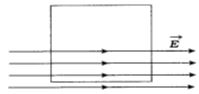
A square surface of side $L$ metres is in the plane of the paper. A uniform electric field $\vec E(V/m) $, also in the plane of the paper, is limited only to the lower half of the square surface, (see figure). The electric flux in SI units associated with the surface is
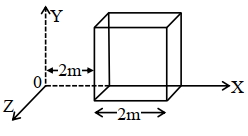
An electric field $\overrightarrow{\mathrm{E}}=(2 \mathrm{xi}) \mathrm{NC}^{-1}$ exists in space. $\mathrm{A}$ cube of side $2 \mathrm{~m}$ is placed in the space as per figure given below. The electric flux through the cube is .................. $\mathrm{Nm}^2 / \mathrm{C}$
In a Young's double slit experiment, the intensities at two points, for the path difference $\frac{\lambda}{4}$ and $\frac{\lambda}{3}$ ( $\lambda$ being the wavelength of light used) are $I_1$ and $I_2$ respectively. If $I_0$ denotes the intensity produced by each one of the individual slits, then $\frac{ I _1+ I _2}{ I _0}=..............$
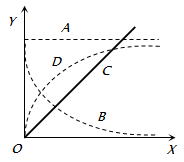
In Fig. X represents time and Y represent activity of a radioactive sample. Then the activity of sample, varies with time according to the curve
Which of the following particles will experience maximum magnetic force circle when projected with the same velocity perpendicular to a magnetic field?
A biconvex lens of refractive index $1.5$ has a focal length of $20 \mathrm{~cm}$ in air. Its focal length when immersed in a liquid of refractive index $1.6$ will be:
The period of oscillation of a magnet in vibration magnetometer is $2 \,sec$. The period of oscillation of a magnet whose magnetic moment is four times that of the first magnet is...$sec$
The example for non-ohmic resistance is