The charges on two plates of a $10\,\mu f$ capacitor are $5\,\mu C$ and $15\,\mu C$ then the potential difference across the capacitor plates is........$V$
Medium
Download our app for free and get started
The charge of the capacitor in expression $Q=C V$ is the magnitude of charge which appears on facing surfaces of plates of capacitor.
The distribution of charge on various faces for present case are shown in figure.
So, here $Q=5\, \mu C$
$\therefore \quad \mathrm{V}=\frac{\mathrm{Q}}{\mathrm{C}}=\frac{5 \times 10^{-6}}{10 \times 14^{-6}}=0.5 \mathrm{\,volt}$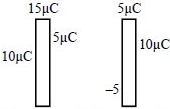

Download our appand get started for free
Experience the future of education. Simply download our apps or reach out to us for more information. Let's shape the future of learning together!No signup needed.*
Similar Questions
- 1View SolutionIf a unit positive charge is taken from one point to another over an equipotential surface, then
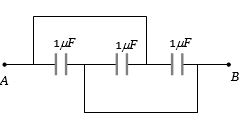
- 2The equivalent capacitance in the circuit between $A$ and $B$ will be.....$\mu \,F$View Solution
- 3capacitor is used to store $24\, watt\, hour$ of energy at $1200\, volt$. What should be the capacitance of the capacitorView Solution
- 4In an electrical circuit, a battery is connected to pass $20\, C$ of charge through it in a certain given time. The potential difference between two plates of the battery is maintained at $15\, V$. The work done by the battery is ........... $J$.View Solution
- 5An electric charge $10^{-8}\ C$ is placed at the point $ (4\,m, 7\,m, 2\,m)$. At the point $(1\,m, 3\,m, 2\,m)$, the electricView Solution
- 6A capacitor of capacitance $C$ is charged to a potential $V$. The flux of the electric field through a closed surface enclosing the positive plate of the capacitor is $......$View Solution
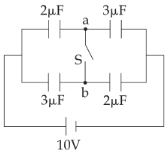
- 7In figure a system of four capacitors connected across a $10\, V$ battery is shown. Charge that will flow from switch $S$ when it is closed isView Solution
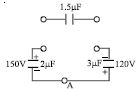
- 8Two capacitors of $2$ $\mu F$ and $3$ $\mu F$ are charged to $150$ $volt$ and $120$ $volt$ respectively. The plates of capacitor are connected as shown in the figure. A discharged capacitor of capacity $1.5$ $\mu F$ falls to the free ends of the wire. ThenView Solution
- 9An elementary particle of mass $m$ and charge $ + e$ is projected with velocity $v$ at a much more massive particle of charge $Ze,$ where $Z > 0.$What is the closest possible approach of the incident particleView Solution
- 10View SolutionThepoints resembling equal potentials are