An electric charge $10^{-8}\ C$ is placed at the point $ (4\,m, 7\,m, 2\,m)$. At the point $(1\,m, 3\,m, 2\,m)$, the electric
Medium


Download our appand get started for free
Experience the future of education. Simply download our apps or reach out to us for more information. Let's shape the future of learning together!No signup needed.*
Similar Questions
- 1View SolutionAn uncharged capacitor is connected to a battery. On charging the capacitor
- 2In a regular polygon of $n$ sides, each corner is at a distance $r$ from the centre. Identical charges are placed at $(n - 1)$ corners. At the centre, the intensity is $E$ and the potential is $V$. The ratio $V/E$ has magnitude.View Solution
- 3A uniform electric field of $20\, N/C$ exists along the $x$ -axis in a space. The potential difference $(V_B -V_A)$ for the point $A(4\,m, 2\,m)$ and $B(6\,m, 5\,m)$ is.....$V$View Solution
- 4A series combination of three capacitors of capacities $1\,\mu \,F,\,2\,\mu \,F$ and $8\,\mu \,F$ is connected to a battery of $e.m.f.$ $13\, volt$. The potential difference across the plates of $2\,\mu \,F$ capacitor will be.....$V$View Solution
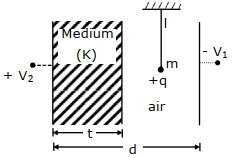
- 5A simple pendulum of mass $'m',$ length $'I'$ and charge $'+q'$ suspended in the electric field produced by two conducting parallel plates as shown. The value of deflection of pendulum in equilibrium position will be -View Solution
- 6A battery does $200 \,J$ of work in charging a capacitor. The energy stored in the capacitor is ......... $J$View Solution
- 7How much kinetic energy will be gained by an $\alpha - $particle in going from a point at $70\,V$ to another point at $50\,V$View Solution
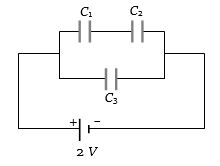
- 8Two capacitors ${C_1} = 2\,\mu \,F$ and ${C_2}\, = \,6\,\mu \,F$ in series, are connected in parallel to a third capacitor ${C_3} = \,4\,\mu \,F$. This arrangement is then connected to a battery of $e.m.f.$ $=$ $2V$, as shown in the figure. How much energy is lost by the battery in charging the capacitorsView Solution
- 9The two metallic plates of radius $r$ are placed at a distance $d$ apart and its capacity is $C$. If a plate of radius $r/2$ and thickness $d$ of dielectric constant $6$ is placed between the plates of the condenser, then its capacity will beView Solution
- 10Four charges $2C, -3C, -4C$ and $5C$ respectively are placed at all the corners of a square. Which of the following statements is true for the point of intersection of the diagonals ?View Solution