MCQ
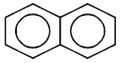
The chemical system that is non-aromatic is
  • A

  • B


  • D

Answer

Correct option: C.

c
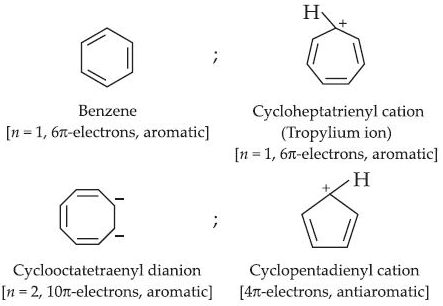
On applying the Huckel rule,

$[(4 n+2) \pi \text { electron }]$ system,
Need a full question paper?

Generate a complete, print-ready paper with questions like this in minutes — across 16+ boards, with answer keys.

Start Generating Free

Similar questions

Consider the following reaction

${C_6}{H_6}(l)\, + \,\frac{{15}}{2}\,{O_2}(g)\, \to \,6\,C{O_2}(g)\, + \,3{H_2}O\,(g)$

Signs of $\Delta H,\,\Delta S$ and $\Delta G$ for the above reaction will be

Assertion : $2-$ Bromobutane on reaction with sodium ethoxide in ethanol gives $1-$ butene as a major product.

Reason : $1-$ Butene is more stable than $2-$ butene According to Saytzeff's rule, $2-$ butene should be the product which is more branched or substituted compound and hence, more stable than butene $-1$ 

The work done during reversible isothermal expansion of one mole of hydrogen gas at $25^{\circ} \mathrm{C}$ from pressure of $20 \mathrm{atmosphere} \mathrm{to} 10 \mathrm{atmosphere}$ is

(Given $R=2.0 \mathrm{cal} \mathrm{K}^{-1} \mathrm{~mol}^{-1}$ )

In sets $A - D$, only one of the set is incorrect regarding basic strength. Select it
The valence bond theory explains the shape, the formation and directional properties of bonds in polyatomic molecules like $\mathrm{CH}_4, \mathrm{NH}_3$ and $\mathrm{H}_2 \mathrm{O}$ etc, in terms of :
The electronic configuration of three elements $A,B$ and $C$ are given below. The molecular formula of the compound formed from $B$ and $C$ will be

$A : 1s^2\, 2s^2\, 2p^6$

$B : 1s^2\, 2s^2\, 2p^6\, 3s^2\, 3p^3$

$C : 1s^2\, 2s^2\, 2p^6\, 3s^2\, 3p^5$

In which of the following arrangement the order is not according to the property indicated in bracket
The oxidation number of $Ba $ in barium peroxide is
Which of the following compounds $+ve$ charge is not show resonance ?
The species having no. $p\pi -p\pi$  bond but has bond order equal to that of $O_2$