The clocktower ("ghantaghar") of Dehradun is famous for the sound of its bell, which can be heard, albeit faintly, upto the outskirts of the city $8 \,km$ away. Let the intensity of this faint sound be $30 \,dB$. The clock is situated $80 \,m$ high. The intensity at the base of the tower is .............$\,dB$
KVPY 2020, Advanced
Download our app for free and get started
(b)
Given, $r_{1}=8 \times 10^{3} \,m , L_{1}=30 \,dB$
$r_{2}=80 \,m , L_{2}=?$
As, $L=10 \log _{10}\left(\frac{I}{I_{0}}\right)$
Also, $\quad I=\frac{P}{A}=\frac{P}{4 \pi r^{2}} \Rightarrow I \propto \frac{1}{r^{2}}$
$\therefore L_{2}-L_{1} =10 \log _{10}\left(\frac{I_{2}}{I_{0}}\right)-10 \log _{10}\left(\frac{I_{1}}{I_{0}}\right)$ $=10 \log _{10}\left(\frac{I_{2}}{I_{1}}\right)$ $=10 \log _{10}\left(\frac{r_{1}}{r_{2}}\right)^{2}$
$L_{2}-30=10 \log _{10}\left(\frac{8000}{80}\right)^{2}$ $=20 \times 2=40$ $\Rightarrow \quad L_{2} =70 \,dB$

Download our appand get started for free
Experience the future of education. Simply download our apps or reach out to us for more information. Let's shape the future of learning together!No signup needed.*
Similar Questions
- 1Two identical flutes produce fundamental notes of frequency $300 Hz$ at ${27^o} C.$ If the temperature of air in one flute is increased to ${31^o}$C, the number of the beats heard per second will beView Solution
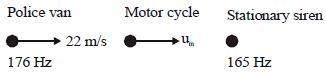
- 2A police van, moving at $22\, m/s$ , chases a motor-cyclist. The police man sounds horn at $176\, Hz$ , while both of them move towards a stationary siren of frequency $165\, Hz$ as shown in the figure. If the motor-cyclist does not observe any beats, his speed must be .... $m/s$ (take the speed of sound $= 330\, m/s$ )View Solution
- 3View SolutionOne Mach number is equal to
- 4A string $1\,\,m$ long is drawn by a $300\,\,Hz$ vibrator attached to its end. The string vibrates in $3$ segments. The speed of transverse waves in the string is equal to .... $m/s$View Solution
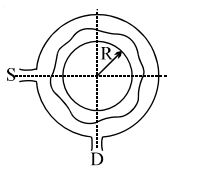
- 5A narrow tube is bent in the form of a circle of radius $R,$ as shown in the figure. Two small holes $S$ and $D$ are made in the tube at the positions right angle to each other. A source placed at $S$ generated a wave of intensity $I_0$ which is equally divided into two parts : One part travels along the longer path, while the other travels along the shorter path. Both the part waves meet at the point $D$ where a detector is placed The maximum value of $\lambda$ to produce a maxima at $D$ is given byView Solution
- 6A stretched string of length $l,$ fixed at both ends can sustain stationary waves of wavelength $\lambda ,$ given byView Solution
- 7An observer standing at station observes frequency $219 Hz$ when a train approaches and $184 Hz$ when train goes away from him. If velocity of sound in air is $340\, m/s$, then velocity of train and actual frequency of whistle will beView Solution
- 8A fork of frequency $256\, Hz$ resonates with a closed organ pipe of length $25.4\, cm$. If the length of pipe be increased by $2\, mm$, the number of beats/sec. will beView Solution
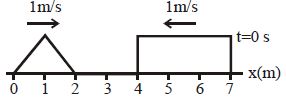
- 9Two pulses on a string approach each other at speeds of $1 m/s$. What is the shape of the string at $t = 3s$ :-View Solution
- 10Following statements are given for a stationary waveView Solution
$(a)$ Every particle has a fixed amplitude which is different from the amplitude of its nearest particle.
$(b)$ All the particles cross their mean position at the same time.
$(c)$ All the particles are oscillating with same amplitude.
$(d)$ There is no net transfer of energy across any plane.
$(e)$ There are some particles which are always at rest.
Which of the following is correct