Two identical flutes produce fundamental notes of frequency $300 Hz$ at ${27^o} C.$ If the temperature of air in one flute is increased to ${31^o}$C, the number of the beats heard per second will be
Diffcult


Download our appand get started for free
Experience the future of education. Simply download our apps or reach out to us for more information. Let's shape the future of learning together!No signup needed.*
Similar Questions
- 1Unlike a laboratory sonometer, a stringed instrument is seldom plucked in the middle. Supposing a sitar string is plucked at about $\frac{1}{4}$th of its length from the end. The most prominent harmonic would beView Solution
- 2The amplitude of a wave represented by displacement equation $y = \frac{1}{{\sqrt a }}\sin \omega t \pm \frac{1}{{\sqrt b }}\cos \omega t$ will beView Solution
- 3A boat at anchor is rocked by waves whose crests are $100\, m$ apart and velocity is $25\, m/sec$. The boat bounces up once in every: ... $sec$View Solution
- 4A transverse wave is described by the equation $Y = {Y_0}\sin 2\pi \left( {ft - \frac{x}{\lambda }} \right)$. The maximum particle velocity is four times the wave velocity ifView Solution
- 5When a tuning fork of frequency $341$ is sounded with another tuning fork, six beats per second are heard. When the second tuning fork is loaded with wax and sounded with the first tuning fork, the number of beats is two per second. The natural frequency of the second tuning fork isView Solution
- 6The superposition takes place between two waves of frequency $f$ and amplitude $a.$ The total intensity is directly proportional toView Solution
- 7A certain string will resonant to several frequencies, the lowest of which is $200 \,cps$. What are the next three higher frequencies to which it resonants?View Solution
- 8A tuning fork whose frequency as given by manufacturer is $512 Hz$ is being tested with an accurate oscillator. It is found that the fork produces a beat of $2 Hz$ when oscillator reads $514 Hz$ but produces a beat of $6 Hz$ when oscillator reads $510 Hz$. The actual frequency of fork is ..... $Hz$View Solution
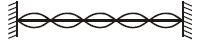
- 9A string fixed at its both ends vibrates in $5\,\,loops$ as shown in the figureView Solution
The total number of nodes and antinodes are respectively
- 10A transverse wave is described by the equation $y = A \,\,sin\,[2\pi (f t - x/\lambda ) ]$.The maximum particle velocity is equal to four times the wave velocity if:View Solution