MCQ
The coefficient of linear expansion depends on
  • A
    The original length of the rod
  • B
    The specific heat of the material of rod
  • C
    The change in temperature of the rod
  • The nature of the metal

Answer

Correct option: D.
The nature of the metal
d

Need a full question paper?

Generate a complete, print-ready paper with questions like this in minutes — across 16+ boards, with answer keys.

Start Generating Free

Similar questions

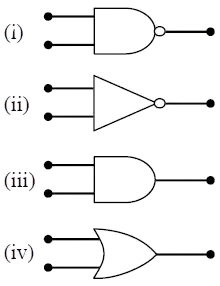
The symbolic representation of four logic gates are given below

The logic symbols for $OR, NOT$ and $NAND$ gates are respectively 
A parallel plate air capacitor is charged to a potential difference of $V$ volts. After disconnecting the charging battery the distance between the plates of the capacitor is increased using an insulating handle. As a result the potential difference between the plates
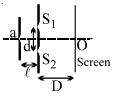
The figure shows a schematic diagram showing the arrangement of Young's Double Slit Experiment Choose the correct statement $(s)$ related to the wavelength of light used
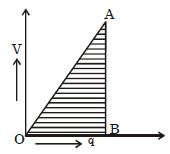
The charge $q$  on a capacitor varies with voltage as shown in figure. The area of the triangle $AOB $ represents
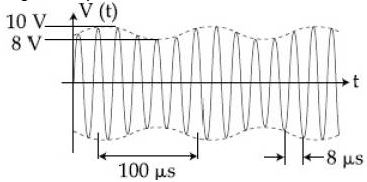
An amplitude modulated signal is plotted below Which one of the following best described the above signal?
The material of fuse wire should have
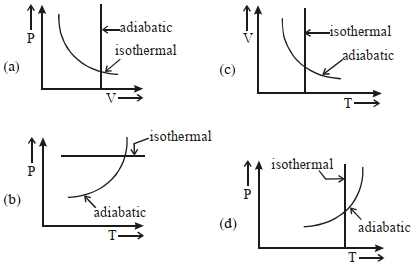
Which one is the correct option for the two different thermodynamic processes ?
There are two plane mirror with reflecting surfaces facing each other. The mirrors are moving with speed $v$ away from each other.$A$ point object is placed between the mirrors. The velocity of the $n$ -th image will be
A student performed the experiment of determination of focal length of a concave mirror by $u-v$ method using an optical bench of length $1.5$ meter. The focal length of the mirror used is $24 \mathrm{~cm}$. The maximum error in the location of the image can be $0.2 \mathrm{~cm}$. The $5$ sets of ( $\mathrm{u}, \mathrm{v})$ values recorded by the student (in $\mathrm{cm}$ ) are: $(42,56$ ), $(48,48),(60,40),(66,33),(78,39)$. The data set$(s)$ that cannot come from experiment and is $(are)$ incorrectly recorded, is $(are)$

$(A)$ $(42,56)$ $(B)$ $(48,48)$ $(C)$ $(66,33)$ $(D)$ $(78,39)$

Given below are two statements :-

Statement $I$ : Davisson-Germer experiment establishes the wave nature of electrons.

Statement $II$ : If electrons have wave nature, they can interfere and show diffraction.

In the light of the above statements choose the correct answer from the options given below