MCQ
The coefficient of linear expansion depends on
  • A
    The original length of the rod
  • B
    The specific heat of the material of rod
  • C
    The change in temperature of the rod
  • The nature of the metal

Answer

Correct option: D.
The nature of the metal
d

Need a full question paper?

Generate a complete, print-ready paper with questions like this in minutes — across 16+ boards, with answer keys.
Start Generating Free

Similar questions

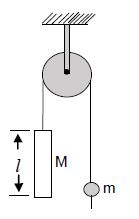
Figure shows an arrangement of a rod of length $l$ and mass $M$ and a bead of mass $m$ attached to a weightless string passing over a frictionless pulley. At $t = 0$ , the bead is in level with the lower end of the rod. The bead slides down the string with considerable friction and is opposite to the other end of the rod after $T\ second$ . Assuming friction between the beadand the string to be constant all through, the frictional force is
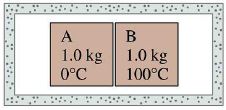
Objects $A$ and $B$ that are initially separated from each other and well isolated from their surroundings are then brought into thermal contact. Initially $T_A= 0^oC$ and $T_B = 100^oC$. The specific heat of $A$ is less than the specific heat of $B$. After some time, the system comes to an equilibrium state. The final temperatures are :
$STATEMENT-1$ The stream of water flowing at high speed from a garcen hose pipe tends to spread like a fountain when held vertically up, but tends to narrow down when held vertically down. and

$STATEMENT-2$ In any steady flow of an incompressible fluid, the volume flow rate of the fluid remains constant.
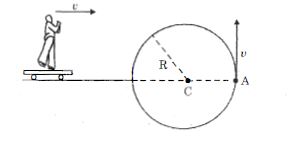
A boy is moving with a constant speed $v$ on a small trolley towards a distant circle as shown in the figure. A point mass is moving on the circle with a constant speed $v$, what is the frequency of change in magnitude of relative velocity of the point mass, as observed by the boy.
A thin bar of length $L$ has a mass per unit length $\lambda $, that increases linearly with distance from one end. If its total mass is $M$ and its mass per unit length at the lighter end is $\lambda_0$, then the distance of the centre of mass from the lighter end is
Among the given following units which one is not unit of length?
The specific heat capacity of a body depends on:
  1. The heat give.
  2. The temperature raised.
  3. The mass of the body.
  4. The material of the body.
A sphere, a cube and a thin circular plate, all made of the same material and having the same mass are initially heated to a temperature of $1000°C$ . Which one of these will cool first
If a propagating wave meets a boundary which is not completely rigid or is an interface between two different elastic media, then which of the statements is/ are correct?
A gas is enclosed in a vessel at a constant temperature at a pressure of $5$ atmosphere and volume $4$ litre. Due to a leakage in the vessel, after some time, the pressure is reduced to $4$ atmosphere. As a result, the