MCQ
The coefficient of restitution $e$ for a perfectly elastic collision is
  • 1
  • B
    $2$
  • C
    $\infty$
  • D
    -1

Answer

Correct option: A.
1
(a)

Need a full question paper?

Generate a complete, print-ready paper with questions like this in minutes — across 16+ boards, with answer keys.
Start Generating Free

Similar questions

A bar of iron is $10 \mathrm{~cm}$ at $20^{\circ} \mathrm{C}$. At $19^{\circ} \mathrm{C}$ it will be $(\alpha$ of iron $=11 \times 10^{-6}$ $\left.\%{ }^{\circ} \mathrm{C}\right)$
If energy $(E)$, velocity $(v)$ and force $(F)$ be taken as fundamental quantity, then what are the dimensions of mass
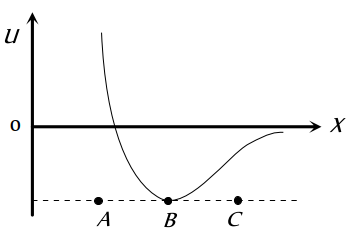
The potential energy $U$ between two molecules as a function of the distance $X$ between them has been shown in the figure. The two molecules are

Image

The magnetic needle of a tangent galvanometer is deflected at an angle $30$ due to a magnet. The horizontal component of earth's magnetic field $0.34 \times 10^{-} T$ is along the plane of the coil. The magnetic intensity is
The speed of a wave in a certain medium is $960 \mathrm{~m} / \mathrm{s}$. If $3600$ waves pass over a certain point of the medium in $1$ minute, the wavelength is
Pressure-temperature relationship for an ideal gas undergoing adiabatic change is $\left(\gamma=C_p / C_v\right)$
A prism $(\mu=1.5)$ has the refracting angle of $30^{\circ}$. The deviation of a monochromatic ray incident normally on its one surface will be $\left(\sin 48^{\circ} 36^{\prime}=0.75\right)$
A step-down transformer is used on a $1000 \mathrm{~V}$ line to deliver $20 \mathrm{~A}$ at $120 V$ at the secondary coil. If the efficiency of the transformer is $80 \%$ the current drawn from the line is .
The period of oscillations of a magnetic needle in a magnetic field is $1.0 \mathrm{sec}$. If the length of the needle is halved by cutting it, the time period will be
A closely wound coil of $100$ turns and area of cross-section $1 \mathrm{~cm}^2$ has a coefficient of self-induction $1 \mathrm{mH}$. The magnetic induction in the centre of the core of the coil when a current of $2 \mathrm{~A}$ flows in it, will be