MCQ
The coefficient of restitution $e$ for a perfectly inelastic collision is
  • A
    $1$
  • $0$
  • C
    $\infty$
  • D
    $-1$

Answer

Correct option: B.
$0$

Need a full question paper?

Generate a complete, print-ready paper with questions like this in minutes — across 16+ boards, with answer keys.

Start Generating Free

Similar questions

A magnet of magnetic moment $M$ and pole strength $m$ is divided in two equal parts, then magnetic moment of each part will be
If $L, C$ and $R$ represent inductance, capacitance and resistance respectively, then which of the following does not represent dimensions of frequency
Mud houses are cooler in summer and warmer in winter because
An object is thrown along a direction inclined at an angle of $45^{\circ}$ with the horizontal direction. The horizontal range of the particle is equal to
The kinetic energy possessed by a body of mass $m$ moving with a velocity $v$ is equal to $\frac{1}{2} m v^2$, provided
Water drops fall at regular intervals from a tap which is $5 m$ above the ground. The third drop is leaving the tap at the instant the first drop touches the ground. How far above the ground is the second drop at that instant
An ideal gas expands in such a manner that its pressure and volume can be related by equation $P V^2=$ constant. During this process, the gas is
Heat is not being exchanged in a body. If its internal energy is increased, then
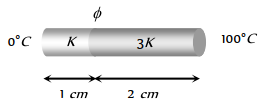
Two bars of thermal conductivities $K$ and $3 K$ and lengths $1 \mathrm{~cm}$ and $2 \mathrm{~cm}$ respectively have equal cross-sectional area, they are joined lengths wise as shown in the figure. If the temperature at the ends of this composite bar is $0^{\circ} \mathrm{C}$ and $100^{\circ} \mathrm{C}$ respectively (see figure), then the temperature $\phi$ of the interface isImage
A sound wave of frequency $v$ travels horizontally to the right. It is reflected from a large vertical plane surface moving to the left with a speed $v$. The speed of sound in the medium is $c$, then
  1. The frequency of the reflected wave is $\frac{v(c+v)}{c-v}$
  2. The wavelength of the reflected wave is $\frac{c(c-v)}{v(c+v)}$
  3. The number of waves striking the surface per second is $\frac{v(c+v)}{c}$
  4. The number of beats heard by a stationary listener to the left of the reflecting surface is $\frac{v v}{c-v}$