MCQ
The coefficient of superficial expansion of a solid is $2 \times 10^{-5} {°C^{-1}}$. It's coefficient of linear expansion is
  • A
    $4 \times 10^{-5} {°C^{-1}}$
  • B
    $3 \times 10^{-5} {°C^{-1}}$
  • C
    $2 \times 10^{-5} {°C^{-1}}$
  • $1 \times 10^{-5} {°C^{-1}}$

Answer

Correct option: D.
$1 \times 10^{-5} {°C^{-1}}$
d
(d) $\alpha = \frac{\beta }{2} = \frac{2 \times 10^{ - 5}}{2} = {10^{ - 5}} {°C^{-1}}$

Need a full question paper?

Generate a complete, print-ready paper with questions like this in minutes — across 16+ boards, with answer keys.

Start Generating Free

Similar questions

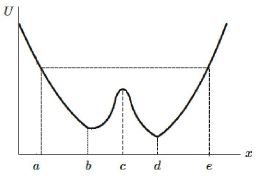
A particle is released from rest at the point $x = a$ and moves along the $x$ axis subject to the potential energy function $U(x)$ shown. The particle:
In the relation $P = \frac{\alpha }{\beta }{e^{ - \frac{{\alpha Z}}{{k\theta }}}}$ $P$ is pressure, $Z$ is the distance, $k$ is Boltzmann constant and $\theta$ is the temperature. The dimensional formula of $\beta$ will be
A jet of water with cross section of $6$ $cm^2$ strikes a wall at an angle of $60^o $ to the normal and rebounds elastically from the wall without losing energy. If the velocity of the water in the jet is $12$ $m/s$, the force acting on the wall is ....... $N$
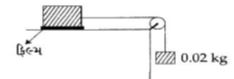
A metal block of base area $0.2\; m ^{2}$ is connected to a $0.02\; kg$ mass via a string that passes over an ideal pulley as shown in figure. A liquid film of thickness $0.6\; mm$ is placed between the block and the table. When released the block moves to the right with a constant speed of $0.17\; m / s$. The co-efficient of viscosity of the liquid is
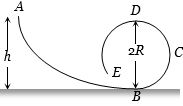
A frictionless track $ABCDE$ ends in a circular loop of radius $R$. A body slides down the track from point $A$ which is at a height $h = 5\, cm$. Maximum value of $R$ for the body to successfully complete the loop is ........... $\mathrm{cm}$
A body weighs $700\, gm$ weight on the surface of the earth. How much will it weigh on the surface of a planet whose mass is $\frac{1}{7}$ and radius is half that of the earth ...... $gm\, wt$
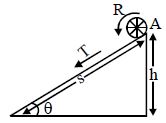
Suppose a body of mass $M$ and radius $R$ is allowed to roll on an inclined plane without slipping from its topmost point $A$. The velocity acquired by the body, as it reaches the bottom of the inclined plane, is given by $\beta  = 1 + \frac{I}{{M{R^2}}}$
A pendulum is suspended in a lift and its period of oscillation when the lift is stationary is  $T_0$. What must be the acceleration of the lift for the period of oscillation of the  pendulum to be $T_0/2$ ?
Two waves of equal amplitude $A$, and equal frequency travel in the same direction in a medium. The amplitude of the resultant wave is:
A sample of gas expands from volume ${V_1}$ to ${V_2}$. The amount of work done by the gas is greatest when the expansion is