MCQ
The coefficient of volume expansion is :
  • A
    less than the coefficent of linear expansion.
  • B
    twice the coefficient of linear expansion.
  • C
    equal to the coefficient of linear expansion
  • thrice the coefficient of linear expansion.

Answer

Correct option: D.
thrice the coefficient of linear expansion.
D

Need a full question paper?

Generate a complete, print-ready paper with questions like this in minutes — across 16+ boards, with answer keys.
Start Generating Free

Similar questions

Two particles are projected simultaneously in the same vertical plane, from the same point on ground, but with same speeds but at different angles $( < 90^o )$ to the horizontal. The path followed by one, as seen by the other, is
A clock has $75 \mathrm{~cm}, 60 \mathrm{~cm}$ long second hand and minute hand respectively. In $30$ minutes duration the tip of second hand will travel $x$ distance more than the tip of minute hand. The value of $x$ in meter is nearly (Take $\pi=3.14$ ) :
A body is projected at such an angle that the horizontal range is three times the greatest height. The angle of projection is
If the Young's modulus of the material is $3$ times its modulus of rigidity, then its volume elasticity will be
A steel wire has linear mass density $6.9 \times 10^{-3}\ kgm^{-1}$. If the wire is under a tension of $60N$, then the speed of the transverse waves on the wire is:
How long will a train, running at a speed of $45\ kmph$ cross a standing man, given the length of the train is $450\ m\ ?$
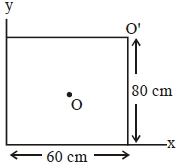
For a uniform rectangular sheet shown in the figure, the ratio of moments of inertia about the axes perpendicular to the sheet and passing through $O$ (the centre of mass) and $O ^{\prime}($ corner point $)$ is 
One mole of a perfect gas in a cylinder fitted with a piston has a pressure $P,$ volume $V$ and temperature $T.$ If the temperature is increased by $1 \,K$ keeping pressure constant, the increase in volume is
A particle has initial velocity $\left( {2\hat i + 3\hat j} \right)$ and acceleration $\left( {0.3\hat i + 0.2\hat j} \right)$. The magnitude of velocity after $10\, seconds$ will be 
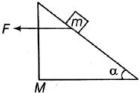
A wooden wedge of mass $M$ and inclination angle $(\alpha)$ rest on a smooth floor. A block of mass $m$ is kept on wedge. A force $F$ is applied on the wedge as shown in the figure such that block remains stationary with respect to wedge. So, magnitude of force $F$ is