MCQ
If the Young's modulus of the material is $3$ times its modulus of rigidity, then its volume elasticity will be
  • A
    Zero
  • Infinity
  • C
    $2 \times {10^{10}}\,N/{m^2}$
  • D
    $3 \times {10^{10}}\,N/{m^2}$

Answer

Correct option: B.
Infinity
b
(b) $Y = 2\eta (1 + \sigma )$$\Rightarrow$ $3\eta = 2\eta (1 + \sigma )$ $\Rightarrow$ $\sigma = \frac{3}{2} - 1 = \frac{1}{2}$

Now substituting the value of $\sigma$ in the following expression.

$Y = 3K(1 - 2\sigma )$ $\Rightarrow$  $K = \frac{Y}{{3(1 - 2\sigma )}} = \infty $

Need a full question paper?

Generate a complete, print-ready paper with questions like this in minutes — across 16+ boards, with answer keys.
Start Generating Free

Similar questions

The velocity of upper layer of water in a river is $36 kmh ^{-1}$. Shearing stress between horizontal layers of water is $10^{-3} Nm ^{-2}$. Depth of the river is $m$. (Co-efficiency of viscosity of water is $10^{-2} \,Pa . s$ )
The displacement of simple harmonic oscillator after $3$ seconds starting from its mean position is equal to half of its amplitude. The time period of harmonic motion is $\dots \; s$
What is the momentum of a $6.0\ kg$ bowling ball with a velocity of $2.2\ m/ s?$
The time period of a satellite of earth is $5$ hours. If the separation between the earth and the satellite is increased to four times the previous value, the new time period will become ......... $hours$
A body lying initially at point $(3,7)$ starts moving with a constant acceleration of $4 \hat{i}$. Its position after $3 \,s$ is given by the co-ordinates ..........
Work done by a system under isothermal change from a volume ${V_1}$ to ${V_2}$ for a gas which obeys Vander Waal's equation $(V - \beta n)\,\left( {P + \frac{{\alpha {n^2}}}{V}} \right) = nRT$
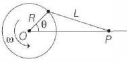
One end of a rod of length $L=1 \,m$ is fixed to a point on the circumference of a wheel of radius $R=1 / \sqrt{3} \,m$. The other end is sliding freely along a straight channel passing through the centre $O$ of the wheel as shown in the figure below. The wheel is rotating with a constant angular velocity $\omega$ about $O$. The speed of the sliding end $P$, when $\theta=60^{\circ}$ is
A thermos bottle filled with tea is shaken vigorously. The internal energy of the system (tea) will :
Time taken to heat water upto a temperature of $40^\circ C ($from room temperature$)$ is $t_1$ and time taken to heat mustard oil $($of same mass and at room temperature$)$ upto a temperature of $40^\circ C$ is $t_2$, then $($given mustard oil has smaller heat capacity$).$
Which pair of the following forces will never give resultant force of $2\, N$