MCQ
The coil in a moving coil Galvanometer experiences torque proportional to current passed through it. If a steady current $i$ is passed through it the deflection of the coil is found to be $90^o$ . Now the steady current is switched off and a charge $Q$ is suddenly passed through the coil. If the coil has $N$ turns of area $A$ each and its moment of inertia is $I$ about the axis it is going to rotate then the maximum angle through which it deflects upon passing $Q$ is
  • $Q\sqrt {\frac{{\pi NAB}}{{2iI}}} $
  • B
    $\frac{{\pi Q}}{2}\sqrt {\frac{{NAB}}{{iI}}} $
  • C
    $\pi Q\sqrt {\frac{{NAB}}{{2iI}}} $
  • D
    $Q\sqrt {\frac{{\pi NAB}}{{iI}}} $

Answer

Correct option: A.
$Q\sqrt {\frac{{\pi NAB}}{{2iI}}} $
a
$\tau=\mathrm{MB}=\mathrm{C} \theta$

$ \Rightarrow {\rm{N}}i{\rm{AB}} = {\rm{C}}\frac{\pi }{2} \Rightarrow {\rm{C}} = \frac{{2{\rm{N}}i{\rm{AB}}}}{\pi }$         ........$(1)$

When $Q$ is passed,

$\int \tau  dt = \int {Ni} ABdt$

$\mathrm{I} \omega=\mathrm{N} \mathrm{A} \mathrm{B} \mathrm{Q}$       ........$(2)$

Also, maximum deflection happens when entire $\frac{1}{2} \mathrm{I} \omega^{2}$ converts to $\frac{1}{2} \mathrm{C} \theta_{\mathrm{max}}^{2}$

So ${\theta _{\max }} = \sqrt {\frac{{{\rm{I}}{\omega ^2}}}{{\rm{C}}}}  = \frac{1}{{\sqrt {{\rm{IC}}} }}{\rm{I}}\omega  = \frac{{{\rm{NABQ}}}}{{\sqrt {{\rm{IC}}} }}$        (from $(1)$)

Need a full question paper?

Generate a complete, print-ready paper with questions like this in minutes — across 16+ boards, with answer keys.

Start Generating Free

Similar questions

In the propagation of electromagnetic waves the angle between the direction of propagation and the plane of vibration is $.....$
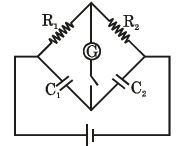
Circuit shown is in steady state, now when switch is closed, galvanometer shows no deflection, then correct relation is
Assertion : Blue colour of sky appears due to scattering of blue colour.
Reason : Blue colour has shortest wave length in visible spectrum.
Which of the following statement is correct in accordance with Kirchhoff's second law?
A moving coil galvanometer has 150 equal divisions. Its current sensitivity is 10 divisions per milliampere and voltage sensitivity is 2 divisions per millivolt. In order that each division reads 1 volt, the resistance in ohms needed to be connected in series with the coil will be
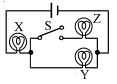
If $X, Y$ and $Z$ in figure are identical lamps, which of the following changes to the brightnesses of the lamps occur when switch $S$ is closed?
A slab of glass, of thickness $6\, cm$ and refractive index $1.5$, is placed in front of a concave mirror, the faces of the slab being perpendicular to the principal axis of the mirror. If the radius of curvature of the mirror is $40\, cm$ and the reflected image coincides with the object, then the distance of the object from the mirror is.....$cm$
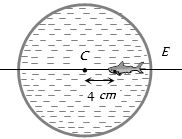
In a thin spherical fish bowl of radius $10 \,cm$ filled with water of refractive index $\left( {\mu = \frac{4}{3}} \right)$ there is a small fish at a distance of $4\, cm$ from the centre $C$ as shown in figure. Where will the image of fish appears, if seen from $E$.....$cm$
An emf of $20\; \mathrm{V}$ is applied at time $\mathrm{t}=0$ to a circuit containing in series $10\; \mathrm{mH}$ inductor and $5 \;\Omega$ resistor. The ratio of the currents at time $\mathrm{t}=\infty$ and at $t=40\; s$ is close to : (Take $e^{2}=7.389$ )
Which one statement is correct ? A parallel plate air condenser is connected with a battery. Its charge, potential, electric field and energy are $Q_0, V_0, E_0$ and $U_0$ respectively. In order to fill the complete space between the plates a dielectric slab is inserted, the battery is still connected. Now the corresponding values Q, V, E and U are in relation with the initially stated as