The colour sequence in a carbon resistor is red, brown, orange and silver. The resistance of the resistor is
Easy


Download our appand get started for free
Experience the future of education. Simply download our apps or reach out to us for more information. Let's shape the future of learning together!No signup needed.*
Similar Questions
- 1An electric heater consists of a nichrome coil and runs under $220 \,V$, consuming $1 \,kW$ power. Part of its coil burned out and it was reconnected after cutting off the burnt portion.The power it will cunsume now isView Solution
- 2Two electric bulbs marked $40\,W,$ $220\,V$ and $60\,W,\,\,220\,V$ when connected in series across same voltage supply of $220\,V,$ the effective power is $P_1$ and when connected in parallel, the effective power is $P_2.$ Then $\frac {P_1}{P_2}$ isView Solution
- 3A metal wire of resistance $3\,\Omega $ is elongated to make a uniform wire of double its previous length. The new wire is now bent and the ends joined to make a circle. If two points on this circle make an angle $60^o$ at the centre, the equivalent resistance between these two points will beView Solution
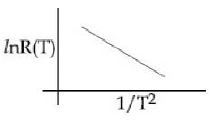
- 4View SolutionIn an experiment, the resistance of a material is plotted as a function of temperature (in some range). As shown in the figure, it is a straight line. One may conclude that:
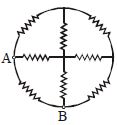
- 5Eight resistances each of resistance $5\,\Omega $ are connected in the circuit as shown in figure. The equivalent resistance between $A$ and $B$ isView Solution
- 6The resistance of a wire is $5 \Omega$. It's new resistance in ohm if stretched to $5$ times of it's original length will be :View Solution
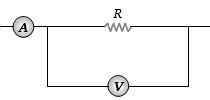
- 7The ammeter $A$ reads $2\, A$ and the voltmeter $V$ reads $20\, V$. the value of resistance $R$ is (Assuming finite resistance's of ammeter and voltmeter)View Solution
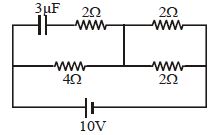
- 8Find charge stored on the capacitor in steady state condition .............. $\mu C$View Solution
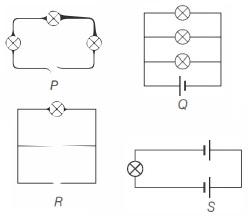
- 9Following figures show different combinations of identical bulb$(s)$ connected to identical battery$(ies)$. Which option is correct regarding the total power dissipated in the circuit?View Solution
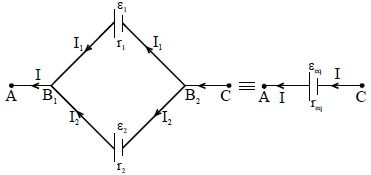
- 10Consider a parallel combination of the cellsshown in the figure.The potential difference in between $B_1$ and $B_2$ isView Solution